
Table of contents
- FROM PLATFORMS TO COMMONS :
- Foreword +
- Part I. Context and Purpose +
- Part II. Core Concepts +
- Part III. Global Landscape Mapping +
- Mechanism Type 1: Public Interest Social Infrastructure
- Mechanism Type 2: Community Data and Open Source AI Ecosystems
- Mechanism Type 3: Governance and Resource Sharing Infrastructures
- Mechanism Type 4: Crisis Ready and Offline Infrastructure
- Mechanism Type 5: Movement Safety and Collective Security
- Regional Snapshots
- Part IV. Gaps, Risks and Opportunities +
- Part V. Action Framework +
- Part VI. Tools, Glossary and References +
- Download report +
Ethical, Inclusive and Safe Design Principles
> 5.2 Ethical, Inclusive and Safe Design Principles
Many of the technologies now available to civil society carry trade-offs that are not always obvious at first glance. Some reduce risk but introduce new forms of dependency. Others improve accessibility yet strain organisational capacity. Given this complexity, it can be helpful to surface a small set of principles that highlight the considerations most likely to shape outcomes.
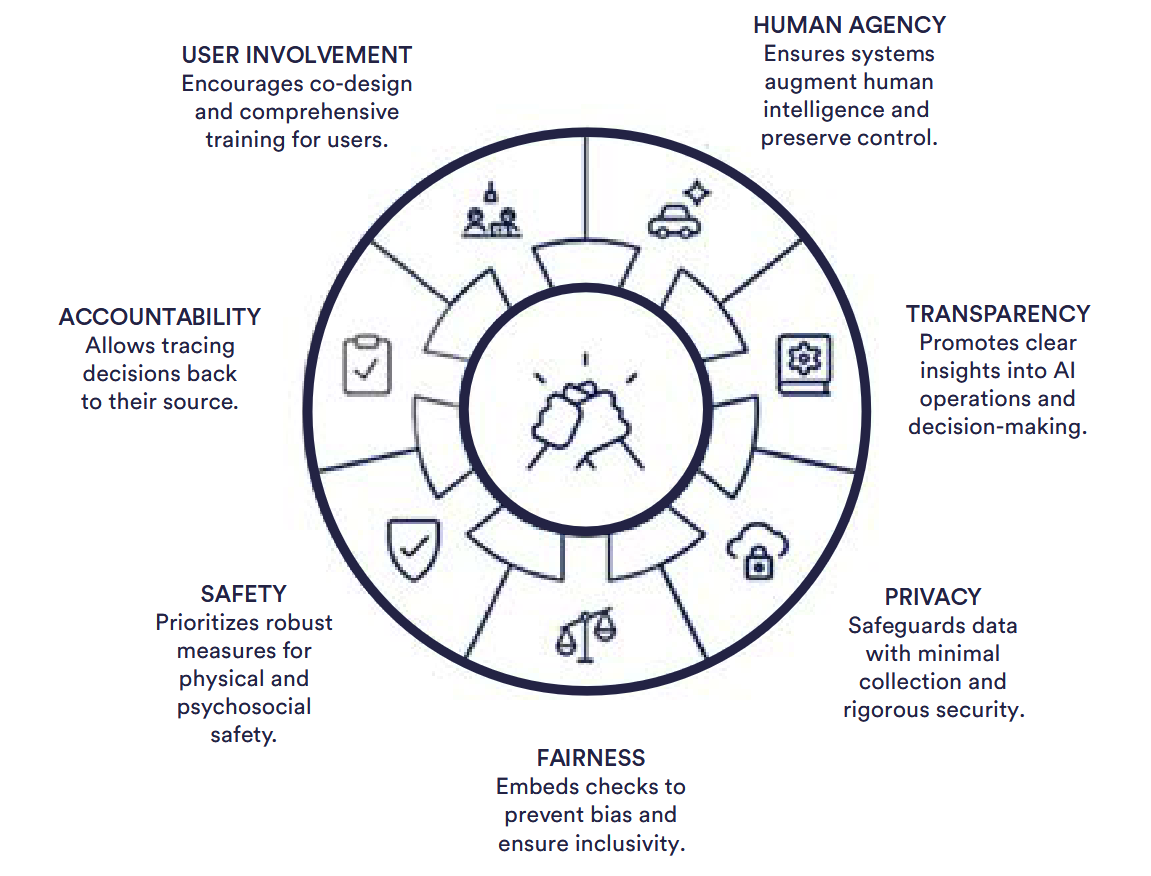
Trust by Design is a framework of principles and practices intended to ensure that collaborative intelligence systems are developed and deployed in ways that inherently foster trustworthiness and ethical behavior, in line with our second research question. The framework, whose core principles are outlined in the guide below is inspired by the concept of “Ethics by Design”, integrating ethical reasoning capabilities and considerations into technology from the earliest stages, but focusing specifically on building trust as the outcome of ethical alignment.
| Principle | What It Means in Practice | Why It Matters | Key Risks if Ignored |
|---|---|---|---|
|
Minimal Data Collection |
Only gather what is essential for the task. Avoid sensitive identifiers unless absolutely required. |
Reduces exposure, complies with rights- based norms, lowers harm in case of breach. |
Data leaks, surveillance, targeting of activists, regulatory liability. |
|
Safe Defaults |
Privacy, encryption and safety settings should be enabled automatically rather than requiring user action. |
Protects high risk users who may not have technical expertise. |
Users remain exposed by accident, inconsistent protection across teams. |
|
Accessibility by Design |
Works with low bandwidth, older devices, screen readers, multiple languages. |
Ensures participation is possible across regions, abilities and connectivity levels. |
Excludes rural communities, disabled users, low income participants. |
|
Transparency of Rules and Changes |
Clear documentation of moderation, data use and governance. Notice before major changes. |
Builds trust and reduces dependency on opaque actors. |
Sudden disruptions, loss of control, inability to contest decisions. |
|
Independent Oversight |
Governance includes external or community voices who can question decisions. |
Prevents concentration of power and strengthens legitimacy. |
Abuse of authority, biased decision making, unaccountable operations. |
|
Interoperability and Open Standards |
Can connect to other tools and move data safely between systems. |
Reduces lock-in and increases resilience. |
Technical or legal dependency on a single provider. |
|
Contextual Safety |
Designed to reflect local risks, including surveillance, gendered harassment and repressive laws. |
Recognises that threats differ by region and community. |
A tool that is safe in one country may be dangerous in another. |
|
Revocability and Exit |
Users can leave, delete data or migrate without penalty. |
Protects autonomy and prevents coercive lock-in. |
Organisations become trapped in systems they cannot exit. |
|
No Hidden Incentives |
Business model, funding and sustainability are clear. |
Ensures values are aligned with public interest, not extractive incentives. |
A “free” tool may depend on data extraction or advertising. |
|
Inclusive Governance |
Affected communities have a role in decision making and dispute resolution. |
Aligns with civil society values and improves long term viability. |
Marginalised communities excluded from rule setting, reinforcing inequities. |
> Practical Considerations
Conditions for Safe and Effective Adoption
Before considering any new infrastructure or governance model, it is essential also to recognise the conditions under which civil society organisations actually operate. Many face political pressure, inconsistent funding, fragile staffing arrangements and limited digital capacity. Others work in environments where connectivity is unreliable or where adopting the wrong tool can place people at real risk. These variations mean that the ability to adopt new systems is not determined by interest or intent, but by the practical realities surrounding an organisation. Understanding these conditions is therefore a prerequisite for any responsible approach to digital transformation.
| Condition | What It Looks Like in Practice | Why It Matters | Risks if Missing |
|---|---|---|---|
|
Organisational Stability |
Basic internal clarity on roles, decision-making and risk ownership during digital change. |
Prevents adoption decisions being driven by crisis or staff turnover. |
Fragmented decisions, poorly managed risk, stalled initiatives. |
|
Minimum Digital Capacity |
Someone in the organisation can evaluate safety, governance and sustainability of tools. Not a technical expert, but a confident evaluator. |
Ensures tools are chosen intentionally, not reactively. |
Adoption of unsafe or unsuitable systems. |
|
Political Feasibility |
Technology choices do not expose staff or communities to surveillance, legal pressure or retaliation. |
Essential for organisations in restrictive civic spaces. |
Heightened threat levels, criminalisation, exposure of participants. |
|
Resource Predictability |
Time, budget and staff continuity to adopt or test tools without overextending. |
Allows for gradual, low- risk experimentation. |
Organisations abandon tools mid-way or create dependency on volunteers. |
|
Connectivity Baseline |
Tools function under real- world conditions: unstable bandwidth, shared devices, low-spec hardware. |
Many contexts still operate on 2G/3G or intermittent access. |
Exclusion of rural and low- income communities; system failure during crises. |
|
Peer Support |
Access to regional or thematic networks for troubleshooting, safety advice and governance guidance. |
Civil society rarely succeeds with digital adoption alone. |
Knowledge gaps, duplicated mistakes, isolation. |
|
Exit Options |
Ability to leave or migrate from a tool without losing data or community trust. |
Avoids lock-in, protects autonomy. |
Dependence on vendors, platforms or infrastructure outside the sector. |
|
Cultural Fit |
Technology aligns with organisational values, workflows and community expectations. |
Tools that clash with organisational culture fail even when technically sound. |
Low uptake, friction, quiet abandonment. |
| Region | Key Characteristics | Notable Initiatives (with links) | Main Challenges | Opportunities |
|---|---|---|---|---|
|
Africa |
Strong community led tech, improving connectivity, frequent shutdowns |
Masakhane (https://www.masakhane.io), Zenzeleni (https://zenzeleni.net), Mesh Bukavu, GovStack adoption (https://www.govstack.global) |
Shutdowns, limited local hosting, reliance on foreign platforms |
Community data ecosystems, public interest connectivity, language AI |
|
Latin America |
Long tradition of digital rights organising, strong open data culture |
Derechos Digitales (https://www.derechosdigitales.org), LatinX NLP (https://latinxnlp.org), Decidim deployments |
Misinformation, political polarisation, uneven infrastructure |
Community governed participation tech, localised AI resources |
|
Middle East and North Africa |
Highly uneven infrastructure, strong digital rights hubs despite repression |
SMEX (https://smex.org), 7amleh (https://7amleh.org), independent tech collectives |
Surveillance, platform bias, shutdowns |
Resilient hosting, shared threat reporting, decentralised alternatives |
|
South Asia |
Large digital populations, identity linked service systems, strong activist networks |
IndiaStack (https://www.indiastack.org), Digital Rights Foundation (https://digitalrightsfoundation.pk) |
Surveillance, access inequalities, pressure on speech |
Privacy preserving verification, community data, alternative comms |
|
Southeast Asia and Pacific |
Active civil society, intense online harassment, climate driven outages |
EngageMedia (https://engagemedia.org), Pacific Digital Rights Observatory, mesh pilots in Fiji and Vanuatu |
Disinformation, harassment, fragile connectivity |
Crisis ready infrastructure, multilingual AI datasets |
|
Europe |
Most developed public interest digital ecosystem, strong regulatory frameworks |
|
Platform dependency, political fragmentation |
Federated services, public interest social networks, open governance |