
GENDER RIGHTS: ROLLBACK AND RESISTANCE

The tone of the global struggle was set in January 2025, when Donald Trump signed a series of executive orders that imposed a strictly binary biological classification of sex, restricted funding for gender-affirming healthcare, ended the recognition of self-identified gender on federal documents, rescinded non-discrimination protections for LGBTQI+ people in healthcare and housing and banned diversity, equity and inclusion (DEI) policies. The Trump administration has pressured businesses to follow suit. Trump-aligned US states have focused on banning the mailing of abortion pills.
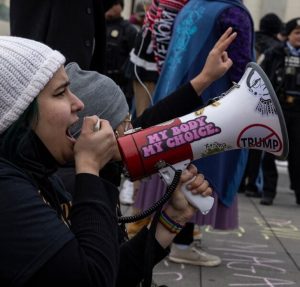
Protesters gather in Washington, DC, USA on 18 January 2025, for a feminist-led weekend of action ahead of Donald Trump’s second inauguration. Photo by Aashish Kiphayet/NurPhoto via AFP
Because of the USA’s global influence, this has provided a blueprint for other leaders who seek to roll back recognition of rights. And because the US government used to be the world’s largest bilateral donor, its axing of foreign aid had immediate global impacts. The dismantling of USAID and the expansion of the global gag rule, which blocks US funding to organisations that perform abortions or advocate for abortion rights, disproportionately affected women, girls and LGBTQI+ people, particularly in conflict zones, rural areas and the world’s poorest countries.
The United Nations’ (UN) Gender Snapshot 2025 sounded the alarm, reporting that the world is badly off-track for every target of Sustainable Development Goal (SDG) 5 on gender equality. It projects that despite women’s unpaid care and domestic work contributing US$10.8 trillion a year to the global economy, 351 million women and girls will remain in extreme poverty by 2030. This setback will likely be invisible to many policymakers due to the slashing of funding for gender-specific data collection in around 70 per cent of national statistical offices.
New technologies compound these challenges. AI systems are embedding and amplifying gender bias, from discriminatory algorithms in hiring tools to chatbots that generate non-consensual intimate imagery at scale. Deepfakes are enabling new forms of abuse and extortion targeting women in public life. Social media platforms are failing to moderate harassment, creating hostile environments that drive women out of public discourse. Weak regulatory frameworks are allowing tech corporations to profit from these harms and evade accountability.
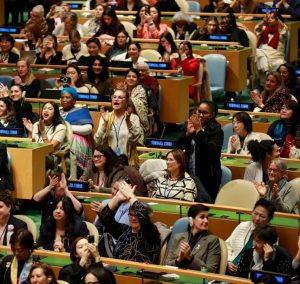
Members of feminist and women’s rights groups take part in the annual CSW69 townhall with the UN Secretary-General on 11 March 2025 at UN headquarters in New York, USA. Photo by UN Women/Ryan Brown
Institutional strain showed at the UN’s 69th Commission on the Status of Women (CSW69) meeting in March 2025. Under pressure from a well-organised anti-rights bloc, the meeting’s Political Declaration stripped out longstanding references to sexual and reproductive health and rights, a move that would have been unthinkable just a few years ago.
Amid regression, civil society has continued to adapt and innovate, often under direct threat, securing tangible results. While some states rolled back recognition of abortion rights, criminalised homosexuality and axed funding, others recognised marriage equality and introduced consent-based definitions of rape. Rights champions also defended progress in global spaces. The launch of the Beijing+30 Action Agenda saw over 100 states renew their commitments to gender justice. At CSW69, activists successfully advocated for the first explicit recognition of gender-based violence (GBV) in the political declaration.
Across countries and political systems, attacks on gender rights are driven by a strikingly consistent discourse that frames equality as a dangerous ideology and depicts feminist and LGBTQI+ struggles as threats to children, national identities and traditional family values. Politicians weaponise gender issues to refocus people’s economic and political anger on easy targets. As a consequence, human rights are increasingly treated as conditional privileges rather than universal protections.
Some states are criminalising the visibility of LGBTQI+ people. In 2025, Hungary passed a law banning Pride marches and other LGBTQI+ public events, authorising surveillance to enforce compliance. This restricted the right to protest while redefining LGBTQI+ visibility as a crime. The law led to the prosecution of Budapest’s mayor for his role in arranging a Pride event in defiance of the ban. Meanwhile the Turkish government declared 2025 the ‘Year of the Family’ and introduced a draft bill to severely curtail LGBTQI+ rights, criminalise advocacy efforts and restrict healthcare access for transgender people. Authorities repressed Istanbul’s Pride and Trans Pride marches, detaining dozens of activists, journalists and lawyers.
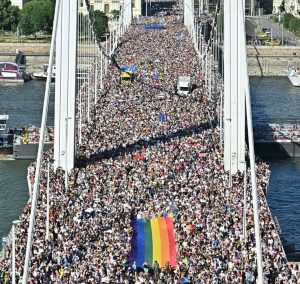
A record-breaking crowd marches in defiance of a government ban during the 30th annual Budapest Pride parade on 28 June 2025 in downtown Budapest, Hungary. Photo by Attila Kisbenedek/AFP
Other states are dismantling equality infrastructure and narrowing legal concepts to exclude transgender people. In the UK, a Supreme Court ruling enabled the legal exclusion of transgender women from single-sex spaces on the grounds that, under the Equality Act, the terms ‘woman’ and ‘sex’ refer exclusively to biological sex. Slovakia’s parliament passed sweeping constitutional amendments that defined sex as exclusively biological, banned legal gender recognition for non-binary and transgender people, restricted adoption to married heterosexual couples, prohibited surrogacy and required parental approval for children to access comprehensive sexuality education. This was a clear attempt to override European Union (EU) directives on non-discrimination and human rights.
Reversing an earlier trend, a wave of criminalisation of same-sex relations has swept Africa, often fuelled by a mix of religious moralising and nationalistic discourse depicting LGBTQI+ rights as foreign impositions. In Burkina Faso, the military junta revised the criminal code to criminalise same-sex relations and their ‘promotion’, punishable by two-to-five-year prison terms. In Kenya, where homosexual acts are illegal under colonial-era laws, the Family Protection Bill 2023, currently stalled in pre-publication stage, seeks to define the family as strictly heterosexual and would introduce severe criminal penalties, including the death penalty, for performing or ‘promoting’ same-sex acts.
Regression has also come in Trinidad and Tobago, where a Court of Appeal ruling reversed the decriminalisation of same-sex relations and reinstated colonial-era penalties of up to 25 years in prison. In many other countries where being homosexual is illegal, such as Senegal and Tunisia, crackdowns have intensified, with people arrested under indecency and morality laws and subjected to forced examinations on the basis of their actual or perceived sexual orientation or gender identity.
In Central Asia, 2025 concluded with Kazakhstan’s president signing into law a Russian-style ‘gay propaganda’ ban prohibiting positive LGBTQI+ representation in education, media and online platforms, enforced through fines and detentions.
Several states are also restricting reproductive rights and asserting control over women’s bodies. In Russia, the government launched a campaign against ‘child-free propaganda’, enforcing a new law that prohibits the promotion of so-called child-free lifestyles in advertising, films, media and online content. This forms part of a wider trend among right-wing populist and nationalist governments seeking to counter falling birth rates, often accompanied by racist narratives rooted in white supremacist conspiracy theories about the replacement of established population groups.
Basic protections of physical integrity such as bans on female genital mutilation (FGM) have come under attack. An attempt to repeal The Gambia’s FGM ban was successfully resisted in late 2024, but the legal battle continues, having now shifted to the Supreme Court.
States beyond the USA are dismantling the infrastructure meant to protect rights under an ‘anti-woke’ narrative. In Argentina, far-right libertarian President Javier Milei withdrew programmes for GBV survivors and is intent on removing femicide from the Penal Code as an aggravating factor in homicide sentences, arguing that gender-specific categories confer privilege.
The situation has deteriorated further in the two countries with gender apartheid systems: Afghanistan and Iran. In Afghanistan, Taliban authorities followed through on decrees aimed at erasing women from public life and restricting their freedom of movement, including by refusing to allow female Afghan staff and contractors to enter UN compounds. In September, the Taliban shut down nationwide internet access on the basis of preventing immorality, effectively closing avenues for education, work and resistance.
In Iran, two and a half years after the Woman, Life, Freedom protests, the government intensified its crackdown on those who supported the movement. 2025 saw a dramatic spike in executions, with at least 1,922 people executed, more than double the number in 2024 and the highest in 15 years. As sustained defiance forced authorities to tolerate unveiled women in major urban centres, they changed enforcement tactics, replacing visible street patrols with bureaucratic and administrative measures and expanding surveillance through drones, facial recognition systems, licence-plate recognition cameras and a government-backed app encouraging people to report hijab violations.
Across the world, civil society is mobilising resistance, blocking, delaying or weakening regressive measures and scoring victories despite hostile conditions.
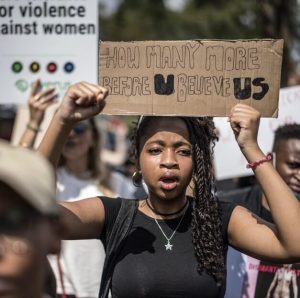
Activists march in Pretoria, South Africa to demand that gender-based violence and femicide be declared a national disaster on 11 April 2025. Photo by Marta Fiorin/Reuters via Gallo Images
Resistance is highly visible on the streets, particularly around two annual focal points: International Women’s Day and Pride season. On 8 March 2025, women all over the world protested against intensifying attacks on rights, denouncing GBV, demanding reproductive rights and voicing solidarity with oppressed communities. Women mobilised against GBV all year long, in response to femicide cases and around 25 November, International Day for the Elimination of Violence against Women. Feminist movements achieved a historic victory in South Africa, where the government declared GBV and femicide a national disaster.
In Latvia, civil society fended off a backlash. The state ratified the Istanbul Convention – the Council of Europe Convention on preventing and combating violence against women and domestic violence – in 2023, and the treaty entered into force in May 2024. But in October 2025, conservative forces held a parliamentary vote on withdrawal, and it took intense pressure from civil society, including large-scale protests and a petition, to pause the withdrawal process until a decision is made after the next election in 2026.
Pride 2025 mobilised resistance: tens of thousands defied the ban in Budapest, braved repression in Istanbul and flocked to WorldPride in Washington DC, refusing to be intimidated by Trump, while Puerto Rico’s Pride turned into an act of civic resistance against the Religious Freedom Act, which allows denial of services to LGBTQI+ people. In another show of resistance, over 100,000 attended London’s Trans+ Pride. People flooded Bangkok’s streets in Asia’s largest Pride, celebrating marriage equality. While the retreat of corporations from DEI policies caused funding challenges for Pride organisers in some global north countries, it offered opportunities to liberate Pride from the private sector’s sanitising influence and rediscover its radical protest roots.
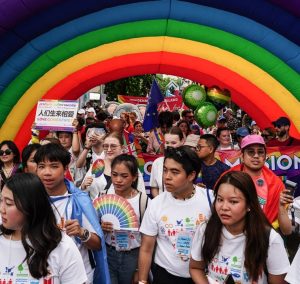
People participate in the Bangkok Pride parade during the opening of Pride Month on 1 June 2025 in Bangkok, Thailand. Photo by Anusak Laowilas/NurPhoto via AFP.
Courts remain crucial battlegrounds, with strategic litigation securing tangible gains. In Poland, a Supreme Court ruling eased barriers to legal gender recognition by removing the requirement that transgender people sue their parents. The Eastern Caribbean Supreme Court struck down St Lucia’s colonial-era laws that criminalised same-sex relations, making it the fifth Caribbean country where homosexuality has been decriminalised in recent years.
At the regional level, the Inter-American Court of Human Rights issued an advisory opinion recognising care as a fundamental human right and urging states to create universal care systems, redistribute care responsibilities more fairly and integrate care into national policies. The decision validated longstanding feminist arguments that care work, often invisible and undervalued, has immense economic and social worth, and provides a legal framework for building fairer societies where care is a shared responsibility.
Courts also advanced women’s bodily integrity and autonomy. The Court of Justice of the Economic Community of West African States delivered a landmark ruling against Sierra Leone, stating that FGM constitutes torture and finding the state had violated its human rights obligations by failing to criminalise it. In Malawi and Nigeria, courts issued rulings that recognised the right to safe abortion for sexual violence survivors, setting significant regional precedents. In the UK, parliament finally repealed a Victorian-era law that criminalised abortion in England and Wales.
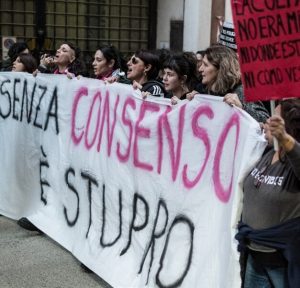
Activists protest a proposed bill that would require victims to prove they physically resisted sexual assault in Rome, Italy on 15 February 2026. Photo by Andrea Ronchini/NurPhoto.
Civil society secured legislative and policy victories beyond the courtroom. Persistent civil society and European institutional pressure led Poland to repeal its final ‘LGBT-free zone’, completing the reversal of a campaign that had seen around 100 municipalities declare themselves hostile to LGBTQI+ people since 2019. Marriage equality laws came into effect in Liechtenstein and Thailand.
Following years of feminist advocacy, at least three additional EU countries – the Czech Republic, France and Poland – adopted consent-based definitions of rape, understood as any sexual act committed without free and explicit consent. A similar bill passed Italy’s lower house only to be undermined by the Senate, which removed consent as a defining element and reverted to the requirement that victims demonstrate explicit refusal.
Civil society advocacy brought progress in Kazakhstan, where a law criminalised forced marriage and eliminated a loophole that allowed perpetrators of bride kidnapping to avoid punishment, and Somalia, where Jubaland state’s new anti-FGM law created momentum that could lead to a comprehensive national law.
Despite the US-driven anti-abortion wave, reproductive rights advanced in Europe. The Faroe Islands, an autonomous territory of Denmark, legalised abortion on request up to 12 weeks, while Denmark and Norway raised the limit from 12 to 18 weeks. The Netherlands authorised general practitioners to prescribe medication abortion up to nine weeks, moving care out of specialised clinics, while lawmakers in Luxembourg abolished a mandatory three-day waiting period and reached an agreement to enshrine ‘abortion freedom’ in the constitution.
In the USA, anti-trafficking coalition World Without Exploitation mobilised to demand passage of the Epstein Files Transparency Act, signed into law in November, with over 20 women sexually exploited by Jeffrey Epstein and Ghislaine Maxwell speaking publicly, many for the first time. The campaign included nationwide billboards, a primetime television ad and direct advocacy, building pressure for legislators to pass the law. Women’s rights activists continue to denounce the protection of wealthy men, whose names are redacted in the released files, while women survivors are re-traumatised through exposure of their identities.
Globally, feminist and women’s rights organisations are campaigning for the election of a feminist woman UN secretary-general and continue to set progressive policy agendas at the CSW and UN High-Level Political Forum, tasked with reviewing progress on the SDGs. At the regional level, they helped shape the Tlatelolco Commitment, adopted at the Regional Conference on Women in Latin America and the Caribbean, which set a decade-long regional agenda focused on gender equality and the care economy, and the European Commission’s Roadmap for Women’s Rights, which established a new legal framework to combat technology-facilitated violence and ensure equal pay across member states by 2030.
International mechanisms brought a promise of accountability for the most severe abuses. Amid an ongoing civil society campaign to have gender apartheid recognised as an international crime, in January 2025 the International Criminal Court issued arrest warrants for Afghanistan’s Taliban leader Haibatullah Akhundzada and his chief justice over persecution on gender grounds.
These victories and setbacks demonstrate that recognition of rights isn’t guaranteed or permanent; rights require constant defence against those seeking to deny them.
Struggles take place within broader structures of democratic erosion. Intensified attacks on women’s and LGBTQI+ rights are part of a deliberate political strategy where gender serves as a battleground for deeper contests over power, authority and the boundaries of democracy. Anti-gender rhetoric is particularly effective in contexts of economic insecurity and political polarisation, where culture war issues can mobilise support and deflect attention from economic and governance failures.
Resistance can take many forms: advocacy, campaigning, litigation, street mobilisation, public defiance and quiet persistence. Each approach responds to different contexts and builds different kinds of power. Resistance is happening even in Afghanistan, where women continue to organise under the most repressive conditions.
Legal victories matter, but activists who’ve secured them also understand the limits. Laws decriminalising homosexuality and recognising transgender rights establish foundations, but alone they can’t dismantle the deeply entrenched prejudices that sustain discrimination and violence. Deeper work of political and social change remains necessary.
Some of civil society’s most important recent victories have been invisible, more about preventing regression than winning progress: stalled laws, softened provisions, uneven enforcement, redirected agendas. Defensive victories rarely make headlines, but they result from sustained advocacy and coalition-building. Without this, the most extreme proposals would advance much further and faster.
Women’s and LGBTQI+ people’s rights remain contested terrain, shaped by the uncertain results of political struggles. Victory isn’t assured, but neither is defeat. The backlash is organised, but so is the resistance. The path forward is being actively forged by those who refuse to accept the unacceptable.