
CLIMATE: BETWEEN BREAKDOWN AND BREAKTHROUGH

At the same time, a renewable energy revolution is underway. Solar and wind power are becoming cheaper to generate and more widely adopted. Renewables now provide over 30 per cent of global electricity. Investments in renewables more than double those in fossil fuels. Asian countries are at the forefront, with China making huge investments in renewables, electric vehicles and high-speed railways. Countries are turning away from coal: in November, South Korea, the world’s fourth-largest thermal coal importer, announced plans to phase out coal-fired power plants. Countries such as Costa Rica, Iceland and Uruguay generate almost all their electricity from renewable sources.
Of course, the picture is complex. Greenhouse gas emissions from electricity generation are only part of the story; there’s also a pressing need to tackle emissions from sources including agriculture, industry and transport. Demand for electricity is rising, with insufficient attention paid to managing consumption and improving efficiency. The huge data centres being built for AI demand massive amounts of electricity and water, with impacts falling disproportionately on global south countries where many are located. Global heating is driving soaring air-conditioning demand. Some states are switching from coal to natural gas, primarily composed of methane, a potent greenhouse gas, and prioritising big projects such as Ethiopia’s controversial dam without paying enough attention to environmental impacts.
Renewable technologies need rare earth minerals, a driver of competition between the major powers of China, Russia and the USA. Extraction brings environmental and human rights costs. Civil society is spreading awareness of systematic abuses in supply chains, including in African countries, Eastern Europe and Central Asia. Communities in Portugal are among those resisting lithium mining, crucial for batteries but impossible to extract without major impacts, and proposing alternatives such as improved recycling.
The trend is no straight line and the fossil fuel industry draws succour from disruptive events such as Russia’s war on Ukraine and Donald Trump’s return to power. Having helped finance Trump’s campaign, fossil fuel companies are reaping the rewards of his shuttering of renewable energy projects and will profit from his intervention in Venezuela.
But the economics are shifting: the business case for fossil fuel extraction is becoming untenable, while the case for renewables is strengthening. Civil society is playing a key role, including through shareholder advocacy. But the switch to renewables threatens fossil fuel firms, so they’re fighting to delay transition for as long as possible. Delay is the new denial, because every day of delay means more profit for fossil fuel corporations – but worse climate impacts for the world’s most vulnerable people.
The fossil fuel industry left COP30, the latest global climate summit, untroubled. Once again, states didn’t commit to speeding up fossil fuel phaseout. Held in Brazil, the summit exemplified the deteriorating state of multilateralism. The Trump administration, in the process of exiting the Paris Agreement, stayed away, creating a leadership vacuum China and the European Union (EU) failed to fill.
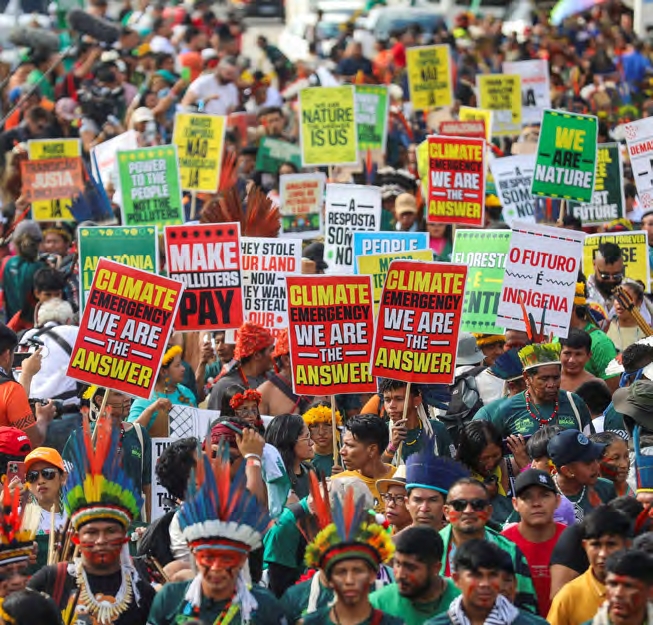
Indigenous people call for climate justice and territorial protection at COP30 in Belem, Brazil, 17 November 2025. Photo by Anderson Coelho/Reuters via Gallo Images
Fractious negotiations led to a compromise that took key responses – a fossil fuel phaseout roadmap, a deforestation plan, an initiative to accelerate implementation of commitments – out of official procedures and into voluntary processes led by willing states. This might yield some progress, but it exposes how broken COP procedures are. Consensus decision-making means a single state can block action, and petrostates such as Saudi Arabia routinely do. When willing states act, unwilling ones can simply opt out, despite being bound by the Paris Agreement.
Another fundamental flaw is the access granted to fossil fuel lobbyists: over 1,600 attended COP30, outnumbering almost all state delegations. In contrast, civil society and Indigenous voices struggle to be heard. COP30 offered more participation opportunities than its last three predecessors, hosted by states with closed civic space, and saw some formal recognition of the rights and roles of Indigenous peoples, but civil society remained largely sidelined and faced militarised security.
COP30’s biggest achievement reflected civil society’s efforts to place social justice at the heart of climate response. The summit approved the Belém Action Mechanism, a work programme on just transition, which civil society has demanded for years. A just transition means fossil fuel phaseout must respect human rights, including labour rights for workers in fossil fuel and transition-related industries. A coordination platform will be created, and civil society is demanding ambition, resources and space for participation.
But progress on the key issue of climate financing fell short. Although European states finally dropped their opposition to tripling annual funding for global south countries to adapt to climate change, the promise remains vague, the 2035 deadline is too distant and the US$120 billion yearly amount falls short of estimated needs. International climate and environmental agreements are hard to forge and harder still to enforce – but funding them may be the hardest thing of all.
News is mixed on other key international environmental protection agreements. A treaty to address the plastics pollution crisis seems no nearer. Ubiquitous plastic waste is a growing environmental disaster and, since plastics are made from fossil fuels, helps drive the climate crisis. The treaty was supposed to be finalised by the end of 2024, but the August 2025 round of talks broke up with no agreement. Progress remains blocked by major oil producers, including Iran, Russia, Saudi Arabia and now the USA, which want a weak treaty that focuses only on managing waste. Civil society and more ambitious states insist the whole of the plastics cycle must be addressed, including limits on production and consumption.
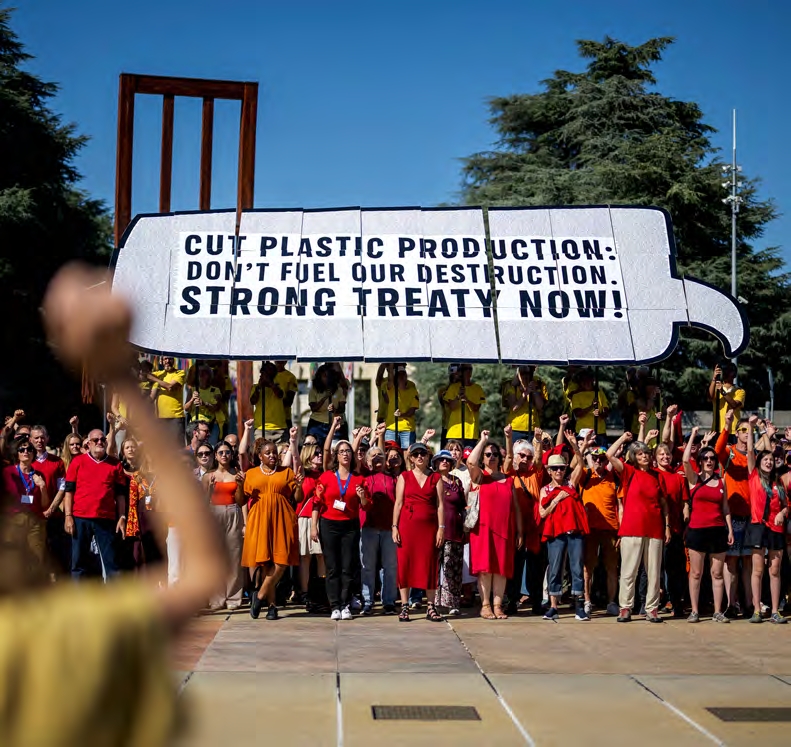
Activists gather outside the United Nations in Geneva on the eve of Plastics Treaty negotiations, 4 August 2025. Photo by Fabrice Coffrini/AFP
Civil society is documenting the problem, providing legal and scientific expertise, advocating with governments and campaigning to raise public awareness. It would rather keep alive hopes of a more ambitious agreement than accept a hurriedly agreed weak treaty. As with COP30, willing states may ultimately proceed on their own, offering progress but potentially creating a regulatory patchwork that lets major polluters escape binding limits.
Civil society is also working with supportive governments to develop a fossil fuel non-proliferation treaty. This would support the Paris Agreement by banning new oil, gas and coal projects and phasing out existing production. Since the initiative was launched in 2020, two civil society organisations, Carbon Tracker and Global Energy Monitor, have developed a Global Registry of Fossil Fuels, a vital step to track the infrastructure the treaty would cover. In 2025, Cambodia and St Kitts and Nevis joined the campaign, bringing the number of supportive states to 18.
A currently stalled initiative however exposes the challenges of contemporary multilateralism. In April, the International Maritime Organization announced an agreement to cut greenhouse gas emissions from shipping through new global fuel standards and charges on high-polluting ships. The deal was due for signature in September, but the Trump administration called it an international tax and threatened treaty supporters with sanctions, causing the vote to be postponed until October 2026. At best, action on a major source of emissions has been delayed; at worst, US threats could kill the agreement.
The EU has also weakened its commitments. Reflecting the growing influence of right-wing parties opposed to climate action, visible also in the EU’s diminished ambition at COP30, the European Parliament has watered down its Corporate Sustainability Due Diligence Directive. The directive, which came after extensive civil society advocacy, originally required large companies to align with the Paris Agreement. It now applies only to the biggest corporations, with reduced reporting requirements.
At least some progress came in September, when the High Seas Treaty passed the threshold of 60 ratifications needed to enter into force. Agreed in 2023 following years of civil society campaigning, the treaty recognises that high seas – the two-thirds of waters beyond national jurisdiction – have virtually no protection and face rising threats such as deep-sea mineral mining. It aims to reverse environmental degradation, destruction of sea life and loss of livelihoods.
The treaty entered into force in January 2026, but some maritime powers and fossil fuel giants haven’t ratified it, creating another patchwork of protection. Civil society is calling for wider ratification and strong enforcement and monitoring mechanisms.
Civil society continues to pressure states and corporations and has achieved some wins. Thanks to campaigning, in 2025 it was revealed that Swedbank, a major banking group, has almost entirely stopped lending to fossil fuel companies.
Climate and environmental litigation has become a powerful tactic. Previously concentrated in the USA, it is now being pursued worldwide. July brought a milestone when the International Court of Justice (ICJ) issued an unprecedented advisory opinion, ruling that states have a legal duty to prevent environmental harm, which requires them to mitigate emissions and adapt to climate change. While the government of Vanuatu brought the case with the backing of other Pacific Island states, it originated in civil society: in 2019, student groups from eight countries formed the Pacific Islands Students Fighting Climate Change network to persuade their governments to seek an ICJ ruling.
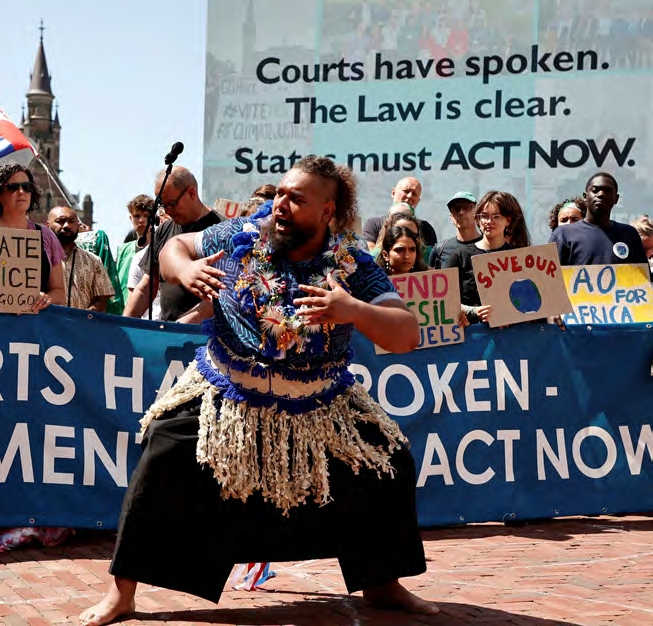
People gather outside the International Court of Justice in The Hague, The Netherlands, ahead of the announcement of its advisory opinion on states’ obligations to protect the climate, 23 July 2025. Photo by Lina Selg/AFP
The ruling rejected arguments by powerful global north states and obstructive petrostates that individual countries can’t be held responsible for their contributions to climate harm. It reaffirmed the importance of the Paris Agreement but also drew from the wider body of international law to make clear that climate change is a human rights issue.
Following extensive civil society engagement, the Inter-American Court of Human Rights issued a similar ruling. It determined that people in the Americas have a right to a healthy and stable climate, meaning states must prevent and adapt to climate change, provide reparations and regulate climate-harming companies. In March, the court also ruled against the government of Ecuador in a case brought by Indigenous groups, ordering it to cease extractive activities in an area where Indigenous people live in voluntary isolation. The African Court for Human and Peoples’ Rights is set to issue an advisory opinion following a petition brought by the African Climate Platform, a civil society coalition.
These rulings can seem symbolic, and COP30 largely overlooked the ICJ’s decision, while the Trump administration is pressuring Vanuatu to drop a UN resolution following up the ruling. But international judgments strengthen national-level legal arguments to hold states and corporations accountable, bolstering civil society’s litigation efforts.
These actions continue to bring important wins. Two South African civil society organisations secured a landmark victory, halting an offshore oil project by Shell and TotalEnergies. The court ruled that the companies’ environmental impact assessments were deeply flawed, having failed to assess the effects of drilling on coastal communities and small-scale fishers. The companies can’t proceed until they’ve completed new, inclusive and comprehensive studies, giving affected communities a chance to keep resisting.
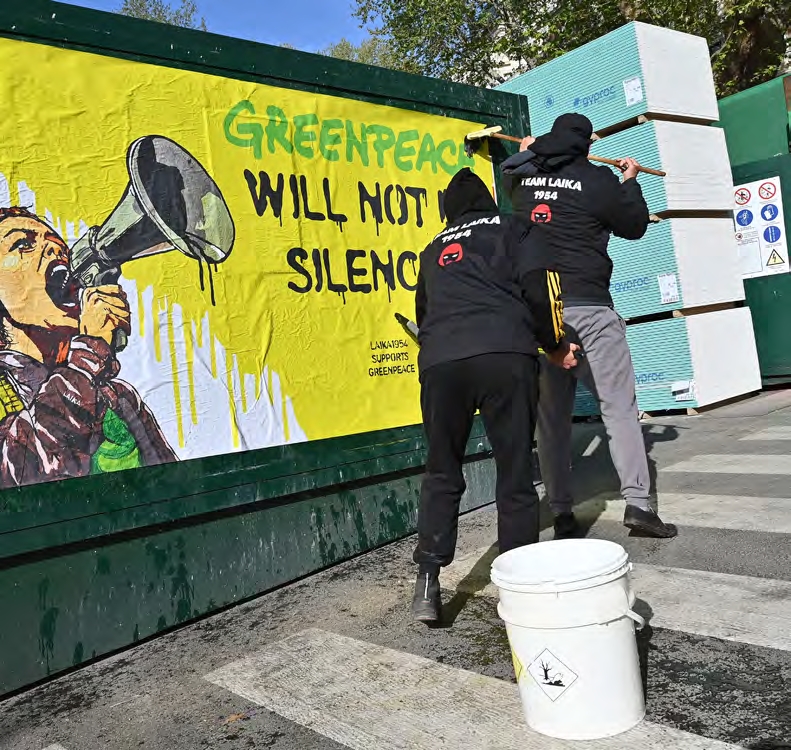
Italian activists paste a banner in support of Greenpeace outside the US Embassy in Rome, Italy on 9 April 2025. Photo by Andreas Solaro/AFP
More litigation is coming. In New Zealand, the Environmental Law Initiative filed a lawsuit after the government weakened its emissions reduction plan without proper consultation, prioritising questionable forest offsets over real cuts. Nigerian communities are suing Shell in UK courts over decades of oil spills in the Niger Delta. Zambian farmers have brought a case against a Chinese mining company after a dam collapsed, releasing mining waste that contaminated water sources thousands depend on.
But civil society is also being targeted. In March, a court in North Dakota, USA, awarded damages of over US$660 million to fossil fuel company Energy Transfer against three Greenpeace organisations. Following a trial international observers condemned as unfair, the court wrongly concluded that Greenpeace orchestrated Indigenous peoples’ protests against pipeline construction on their land.
This was clearly a strategic lawsuit against public participation (SLAPP), a legal action designed to silence legitimate criticism. Greenpeace Romania faces another SLAPP seeking its dissolution, filed by state-owned energy corporation Romgaz in retaliation for its campaign against a gas project. Romania’s energy minister has urged companies to sue environmental groups. But Greenpeace International is fighting back, taking legal action in the Netherlands under the EU’s anti-SLAPP directive, seeking to have the Energy Transfer lawsuit dismissed. Unfair attacks by powerful corporations are helping recruit public support.
Climate and environmental activists and Indigenous and land rights defenders are keeping up the pressure, including through advocacy, campaigns and protests, but they face severe state and corporate repression, including criminalisation and violence.
2025 provides many examples. In Cambodia, journalists were shot at and assaulted for documenting illegal logging. An Indonesian court jailed 11 Indigenous community members for obstructing nickel mining. Mexican activist Cristino Castro Perea, who worked to protect beaches and mangroves, was shot dead. In Chile, where the government weakened environmental laws, Indigenous women activists experienced intimidation, judicial harassment and violent attacks for opposing large-scale development projects. In Peru, police used teargas and non-lethal weapons against people blocking a road to protest against a mine. In Uganda, authorities arrested 11 activists for protesting against the construction of the East African Crude Oil Pipeline.
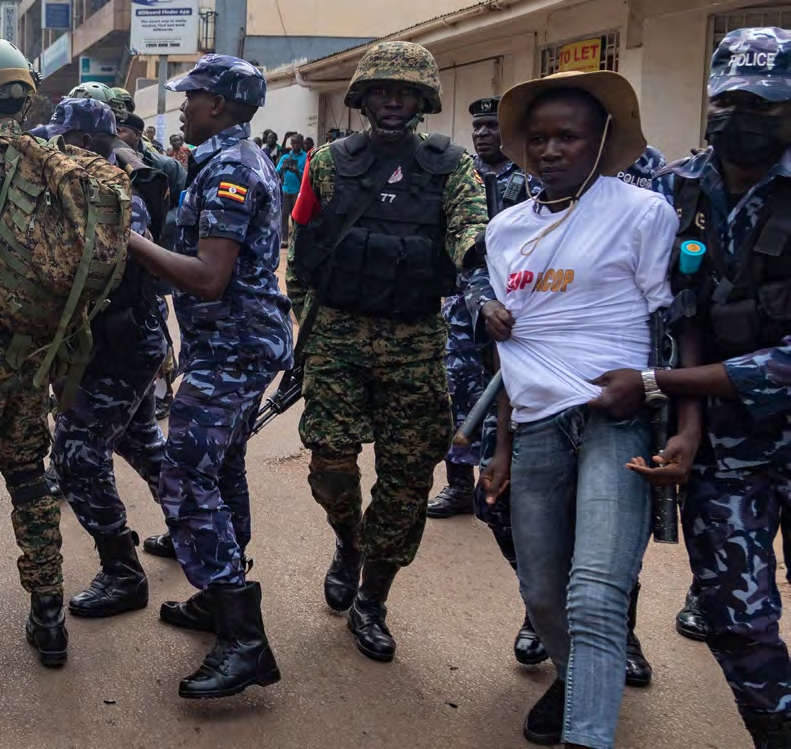
Police officers arrest people protesting against the East African Crude Oil Pipeline Project in Kampala, Uganda, 26 August 2024. Photo by Badru Katumba/AFP
The French government has repeatedly vilified environmental campaigners and deployed police violence against protests, while the German government launched an inquiry into public funding of environmental groups and other organisations. In January, the Dutch parliament adopted a motion declaring Extinction Rebellion an ‘unlawful, society-disrupting and vandalistic organisation’, urging the removal of its tax-exempt status. The Portuguese government named environmental groups in a section on terrorism of its annual security report. New Zealand authorities arrested numerous people at climate and environmental protests.
Civil society is resisting repression and adapting. Australia has become a world leader in arresting climate and environmental protesters, with extensive anti-protest laws introduced in recent years. Responses include the establishment of Climate Defenders Australia, the country’s first not-for-profit legal service that defends climate protesters, counters corporate SLAPPs and sues police for overreach.
Adaptation to repression, however, brings costs. Civil society must invest time and money in defensive measures. This diverts energy from demanding states and corporations cut emissions and fund the transition. At a time when every day of delay matters, civil society restrictions will worsen climate impacts. States and corporations must at a minimum respect civil society’s right to demand the climate action so urgently needed.