
MIGRATION: CRUELTY AS POLICY

Mobility is inherent to the human condition and has shaped civilisations for millennia, but contemporary political discourse frames it as an unprecedented threat. Across regions and political contexts, politicians deploy similar narratives that portray migrants and refugees as welfare dependants, labour market threats, dangers to national cohesion, criminals and terrorists. This enables them to redirect public economic and political frustration away from their failures and onto the most vulnerable.
During the 2024 election campaign, Donald Trump promised to launch the largest deportation in US history. He’s done so through legal, institutional and operational changes that have dismantled the refugee and migrant protection system. On his first day in office, he suspended refugee admissions and resettlement and ended protections from Immigration and Customs Enforcement (ICE) raids for churches, hospitals and schools. His government went on to set the 2026 refugee admissions ceiling ridiculously low, at 7,500, with priority for white South Africans, justified by false claims that they’re the victims of ‘white genocide’, a narrative Trump has long promoted that Elon Musk has amplified.
The Trump administration ended Temporary Protected Status for over a million people from Afghanistan, Cameroon, Haiti, Honduras, Nepal, Nicaragua and Venezuela. It made a deal with El Salvador’s authoritarian President Nayib Bukele to transfer deportees to a massive high-security prison housing alleged gang members, for an annual payment of US$6 million. In March it invoked the 1798 Alien Enemies Act to deport around 250 Venezuelans to El Salvador without due process. Overall, it stripped legal status from over 1.6 million people who entered the USA through humanitarian programmes.
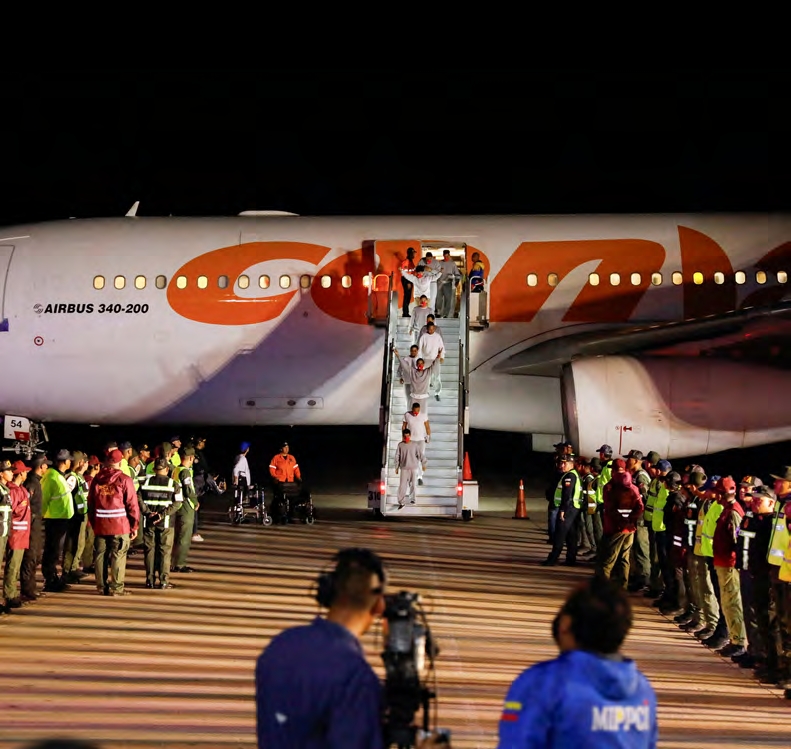
Venezuelan migrants arrive at the Simón Bolívar International Airport in Maiquetía, Venezuela, on a deportation flight from Guantánamo Bay on 20 February 2025. Photo by Leonardo Fernandez Viloria/Reuters via Gallo Images
The ‘Big Beautiful Bill’ Trump signed on 4 July allocated around US$171 billion for immigration enforcement, including US$47 billion for border wall construction, US$45 billion for detention and US$15 billion for deportations. His government expanded its travel ban from 19 countries in June to 39 by December, and in January it froze visa processing for 75 countries.
To enforce restrictions, the government hired over 12,000 additional ICE agents, lowering entry requirements and slashing training time. The hastily deployed, ill-trained officers were instructed to be ‘creative’ and arrest ‘collaterals’ to meet a 3,000 daily arrest quota.
ICE has conducted mass raids across the USA, including at workplaces and outside schools. Arrests have been largely arbitrary: 95 per cent of detained people have no convictions for violent offences and 73 per cent have no criminal convictions at all. Hundreds of US citizens and legal residents have been wrongfully arrested and some deported, including in direct violation of court orders. Agents have been recorded shattering car windows, punching people, using battering rams on front doors and deploying banned arrest manoeuvres such as chokeholds. ICE and Customs and Border Protection agents have so far shot at people in 17 incidents, killing five, including two anti-ICE protesters, and injuring seven.
In Europe, a key strategy is the outsourcing of migration enforcement by paying other states to intercept boats and prevent departures, and establishing offshore processing centres in other countries.
The EU now has border enforcement agreements with Lebanon, Libya, Mauritania and Tunisia. EU funding enables the Libyan coastguard to intercept migrants and refugees in the Mediterranean and take them to Libya, where they’re held in camps in conditions UN experts have described as likely amounting to crimes against humanity. In August, the Libyan coastguard opened fire on an SOS Méditerranée rescue ship in international waters, using a vessel provided by Italy under an EU-funded programme.
The Italian government continues its policy of holding civil society-run rescue ships in port and assigning them distant disembarkation ports to keep them away from the places they’re needed. Between February 2023 and June 2025, authorities held back ships 29 times. In July 2025, Italy’s Constitutional Court declared these orders illegal, ruling that the international Law of the Sea can’t be circumvented by punitive national legislation.
Under Giorgia Meloni’s far-right government, Italy became Europe’s pioneer in external processing through an agreement with Albania, which opened detention centres in October 2024. A court, however, ruled the detention of migrants for processing in a non-EU country illegal, forcing their return to Italy; the government repurposed the centres to detain migrants with no permission to stay in Italy, while introducing a stricter immigration bill. The EU’s Migration Management Regulation, coming into force in June 2026, may allow it to resume its Albania scheme.

A protester holds a sign reading ‘They flee poverty and death while we discuss identity papers’ at an International Migrants Day demonstration in Paris, France, on 18 December 2025. Photo by Jerome Gilles/NurPhoto via AFP
The European Commission has also proposed a sweeping new Return Regulation, intended to create an EU-wide system to speed up deportations. The proposal, currently subject to negotiation in the European Parliament, introduces mutual recognition of return decisions across member states, longer detention periods and the possibility of so-called ‘return hubs’ in non-EU countries. Civil society warns that it risks normalising illegal returns, expanding arbitrary detention and undermining access to legal remedies.
European states are following the path laid down by Australia, which first set up a scheme to detain asylum seekers in Nauru and Papua New Guinea in 2001, and revived it in 2012. In 2025, it struck a further deal to deport to Nauru people previously released from indefinite detention by a court order.
States are systematically denying asylum claims, with Greece going further with a new law to punish ‘illegal stay’ and ‘illegal entry’ with prison sentences of at least two years. In February 2026, the European Parliament approved the first EU-wide list of supposedly safe countries of origin to accelerate deportations. Civil society has rejected this for placing an unfair burden on asylum seekers to prove why they shouldn’t be deported.
Other approaches are possible: over a dozen Latin American and Caribbean states, with far fewer resources than Europe, have recently agreed to strengthen protection, regularisation and integration for asylum seekers, migrants, refugees and returnees.
Much of Europe’s regression is driven by electoral politics. Its rightward shift on immigration policy results from far-right parties gaining power and mainstream parties embracing restrictive policies to limit their appeal. In Austria, where the far-right Freedom Party came first in the 2024 election, the centrist government formed to exclude it from office nonetheless adopted parts of its agenda. In 2025, it halted family reunification for asylum seekers, despite minimal application numbers, claiming pressure on education, housing and healthcare systems, and banned young girls from wearing headscarves in schools. In the first half of the year, Austria forcibly returned 3,188 people.
Immigration was one of the central issues in Germany’s February 2025 election, when the far-right Alternative for Germany party secured its highest-ever vote after campaigning on mass deportations. The mainstream conservative ruling party has cooperated with it on parliamentary votes on immigration and promised stricter policies. Germany’s new government has substantially increased deportations, suspended family reunification and reduced social assistance and integration programmes.
In the Netherlands, immigration remained a key issue in a snap election held in October after the government collapsed when the far-right Party for Freedom withdrew over disagreements about immigration. During the campaign, the centre-left D66 party promised immigration restrictions, including the processing of asylum claims in migrants’ countries of origin.
Some global south states have hardened their policies too. India expelled hundreds of Rohingya refugees to Bangladesh. Egypt returned hundreds of Sudanese refugees as part of a supposedly voluntary scheme jointly administered with Sudan. Thailand deported Uyghur refugees to China, despite the obvious risks of persecution. The Dominican Republic deported over 310,000 Haitians. Following the end of Syria’s civil war in December 2024, Lebanon’s government launched a return plan for Syrians and intensified pressure on people without legal status to regularise their paperwork or join state-led return programmes. By the end of the year, over half a million had left.
Iran and Pakistan carried out the year’s largest mass deportation campaign, expelling around 2.8 million Afghans, thrusting them into Taliban territory. Pakistan ordered the deportation of 1.4 million registered refugees holding UN-issued cards, bypassing judicial oversight and detaining people from their homes, marketplaces and schools. Following its conflict with Israel, Iran accused Afghans of spying for Israel and broadcast forced confessions. Expulsions rose to between 30,000 and 51,000 a day.
Civil society is mounting coordinated resistance, with advocacy coalitions seeking legal and policy reforms, groups taking legal action to block regressive policies, grassroots organisers sustaining essential services, people mobilising in solidarity and community networks physically obstructing deportation operations. It has secured significant victories despite the hostile political climate.
Two notable policy reforms were won in Spain and Thailand in 2025. Spain’s regularisation of 500,000 undocumented migrants resulted from a campaign that collected over 700,000 signatures to propose changes to regulations. In Thailand, the decision to recognise the right to work for Myanmar refugees, with around 80,000 people becoming eligible for work permits, followed years of civil society groundwork.
Courts have provided critical checks on restrictive policies. The US Supreme Court ordered the government to facilitate the return of a wrongfully deported Salvadoran man and ruled that deporting Venezuelan migrants under the 1798 Alien Enemies Act violated constitutional due process guarantees. Civil society secured further victories when judges blocked fast-track deportations, halted use of the Alien Enemies Act and declared Trump’s deployment of the National Guard against Los Angeles protesters illegal.
In South Africa, a court struck down policies that denied asylum seekers access to the asylum system, leading to their arrest and deportation without due process, while another court ordered the anti-migrant group Operation Dudula to stop blocking migrants from accessing public health facilities and schools. Australia’s High Court ruled that imposing strict curfews and ankle bracelets on released refugees without individual judicial risk assessment is unconstitutional.
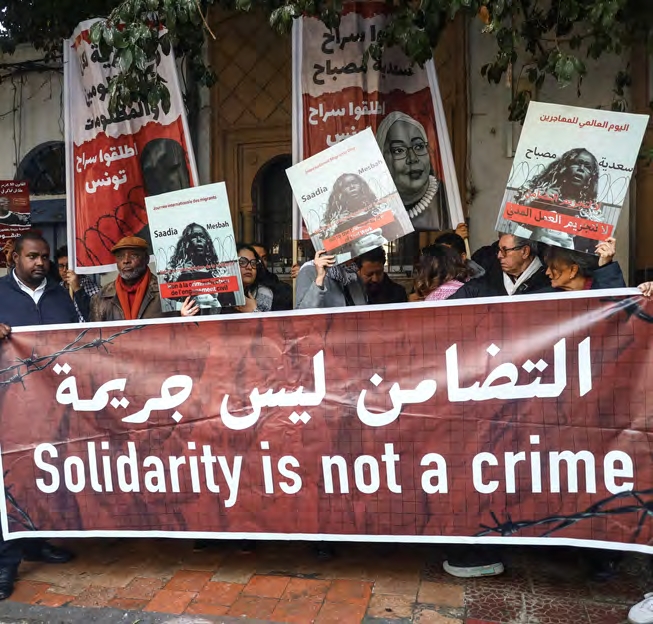
Protesters gather outside the Court of First Instance in Tunis, Tunisia, on 22 December 2025 to support detained anti-racism activist Saadia Mosbah, accused of money laundering and facilitating the illegal entry of migrants. Photo by Chedly Ben Ibrahim/NurPhoto
Courts also vindicated criminalised humanitarian workers. In Greece, 24 aid workers were acquitted of human trafficking charges in January 2026, after seven years in legal limbo. The European Court of Human Rights also ruled against Greece over systematic illegal deportations. In Italy, the Constitutional Court ruled that any order conflicting with the duty to save lives isn’t legally binding, and people can’t be penalised for refusing to comply. Other Italian courts found seizure of rescue ships unlawful.
Despite criminalisation, civil society continues providing life-saving assistance on migration routes, including through search-and-rescue operations. In November, Doctors Without Borders relaunched its activities with a new ship after Italy’s restrictions forced the old one out of service. Civil society organisations are supporting education, food and health initiatives in camps and offering legal counselling, psychosocial programmes and employment support in host communities, with many focusing on the risks and needs of particularly vulnerable groups of refugees, including children, LGBTQI+ people and women.
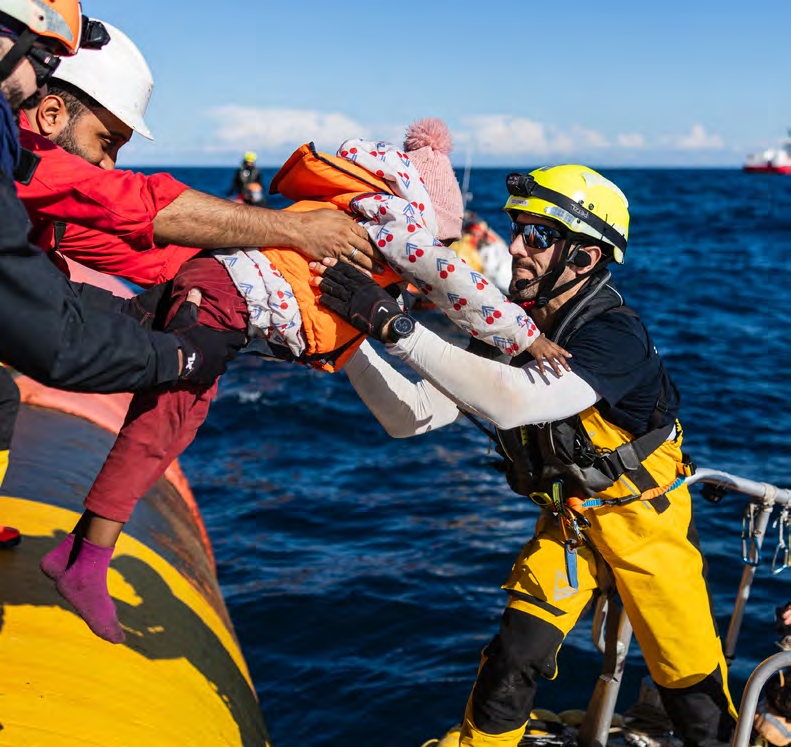
Crew members of the Ocean Viking, a rescue ship operated by SOS Méditerranée, evacuate a child from an oil tanker in international waters between Malta and Tunisia on 31 December 2025. Photo by Sameer Al-Doumy/AFP
A growing number of groups are providing comprehensive legal aid, with the International Refugee Assistance Project offering legal services to displaced people in over a hundred countries and US groups mobilising thousands of volunteer lawyers to provide free representation for asylum seekers and people in detention. They face risks: in the UK, lawyers and activists working with refugees reported receiving rape and death threats from far-right anti-migrant protesters. Threats forced at least two organisations to close, while others must spend more of their limited resources on safety.
Many people are taking to the streets in solidarity with migrants and refugees. In Europe, protests are seeking to counter rising anti-migrant sentiment that comes with growing far-right influence. In January, Italians took to the streets of Palermo alongside migrants to call for policy changes to make it easier to get residence permits and citizenship. In February, at least 160,000 people marched in Berlin against the ruling party’s cooperation with the far right, and over 220,000 protested in other German cities. In June, civil society groups organised a Stand Up to Racism rally in Belfast, UK, following a spate of racist attacks. In August, the UK saw mobilisations in response to anti-migrant protests. In October, thousands marched in solidarity through Dublin, Ireland.
In the USA, mass mobilisation against immigration enforcement has reached record levels, with hundreds of protests across all states in the first months of 2025. The Day Without Immigrants on 3 February saw people stay home from school and work in protest against the Trump administration’s immigration policies, while No Kings Day protests on 14 June drew over five million people nationwide, and over seven million took part in the second edition in October. Faith-based groups coordinated court observation events, marches and vigils during National Migration Week in September. Students protested against ICE during the February 2026 Winter Olympics opening ceremony in Italy.
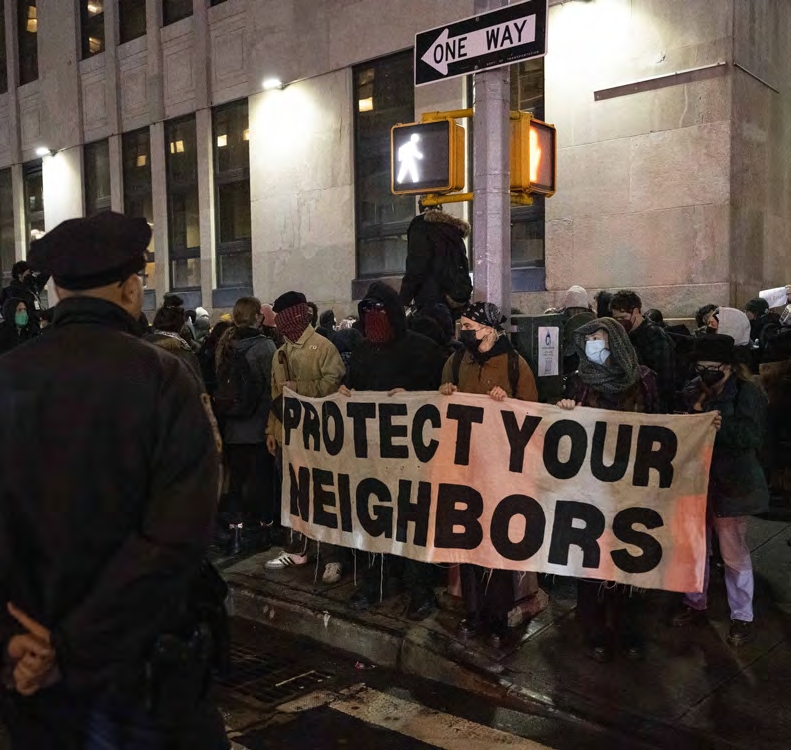
People march against ICE raids in New York, USA, on 13 February 2025. Photo by Mostafa Bassim/Anadolu via Getty Images.
Early on, people held protests at ICE detention facilities and ICE recruitment events, and at airports to target deportation flights, with activists launching boycott campaigns against airlines providing planes and logistics companies servicing flights. But as ICE moved into neighbourhoods, protests have increasingly focused on community defence, with people creating early warning systems and physically intervening to stop arrests. People have formed ICE-watch groups to document agents’ actions and alert migrant neighbours. They’ve organised know-your rights training, established community hotlines to report ICE activity and, in some cases, defence hubs with a steady presence at key locations to disrupt ICE operations. They’ve advised businesses what to do if ICE appears and trained volunteers to identify undercover agents and vehicles, document raids and locate detained people. They’ve coordinated rapid response, organising food and financial support for detained workers, translating legal documents and providing legal aid. Some have blocked ICE raids and chased officers away.
The US government has responded to resistance with criminalisation and violence. Authorities have labelled protesters extremists, violent anarchists and domestic terrorists. The Department of Justice has brought criminal cases against hundreds of protesters, charging many with felony assault. Yet this criminalisation campaign has largely failed: most charges have been reduced or dismissed, and the few trials held have resulted in acquittals.
State violence has had more enduring effects. Federal agents have deployed pepper balls and pepper spray, stun grenades and teargas against protesters, inflicting serious injuries. The most severe violence has come in Minneapolis, Minnesota, where federal agents killed two protesters, Renee Good and Alex Pretti, during Operation Metro Surge in January 2026. UN human rights experts warned the killings could constitute extrajudicial executions. Days later in Hartford, Connecticut, an ICE van knocked down a protester at a vigil for Renee Good.
The forces of restriction are gaining ground. Policies once considered unthinkable – mass deportations, offshore processing in authoritarian states, systematic denial of legal representation – have become a reality. Anti-migrant rhetoric has proved highly effective in justifying measures that violate international law.
Yet civil society’s resistance shows that regression can be reversed. Resistance must remain strong, for at stake are binding legal obligations under international law. The 1951 Refugee Convention, its principle of non-refoulement and due process guarantees aren’t optional. By insisting on their enforcement, civil society contests the normalisation of the extreme and asserts that migration isn’t a modern crisis to be tackled through exclusion, but a permanent feature of the human story that must be met with humanity.