
OVERVIEW: RESISTANCE AGAINST THE TIDE

Powerful states are seeking to reshape the world into spheres of influence, coercing the rest into compliance and tearing up the international rulebook in the process. The global order is buckling under a deliberate assault. Several states are withdrawing from and defunding institutions designed to hold them to account, including the International Criminal Court (ICC) and United Nations (UN) human rights bodies, fragmenting the international system into a patchwork where impunity thrives. The concerted campaign against UN Special Rapporteur Francesca Albanese, threatened and smeared by Israel and the USA simply for doing her job of reporting on human rights violations in Gaza, shows how far governments will go to silence those who hold them to account.
Impunity is becoming normalised in conflicts, leaving millions in danger and misery. Israel and Russia are among the states flouting international humanitarian law, deliberately killing civilians and targeting civil society and journalists. In Sudan, atrocities continue to be met with international silence. Civilians are being killed in the latest US and Israeli airstrikes on Iran. Launched in defiance of international law, these strikes bring the risk of wider regional conflict.
Influential states are choosing to overlook human rights crimes, narrowly focusing on material interests. When they intervene, it’s increasingly through transactional deal-making in pursuit of economic and strategic advantage, such as access to fossil fuels and minerals, while ignoring atrocities and the root causes of conflict.
Many states are prioritising military power over diplomacy. Soaring military spending, often at the expense of international aid, is fuelling a dangerous arms race and stoking nuclear proliferation fears. Arms corporations are developing increasingly deadly weapons with little oversight and no political leadership to contain them. Combined with impunity and fraying international rules, this is a recipe for escalating warfare.
An axis of unaccountable power is flexing its muscles as economic, military, political and technological elites converge. Tech oligarchs are aligning with authoritarian, nationalist and populist leaders and even more extremist ideologues. They’re using the vast reach of their platforms to spread conspiracy theories, disinformation and hatred while defying regulation efforts. A battle for AI supremacy is unfolding with scant oversight; this is supercharging online hatred and enabling the most intrusive surveillance regimes in human history, as states weaken regulation for fear of losing economic and strategic advantage. Tech companies are increasingly embedding themselves in military forces, putting their code and data at the service of automated death and destruction.
A global scramble for the materials needed to power new technologies is reshaping geopolitical alignments, fuelling conflict and driving extractive relationships that benefit powerful states at the expense of communities in resource-rich global south countries.
As economies fail billions of people, economic and political elites are amassing unimaginable wealth and reaping the rewards of corruption. The fossil fuel industry is deliberately delaying climate action, because every day of delay means more profit, at a mounting cost in human suffering. States and corporations are attacking those who defend the environment and demand urgent climate action. Democratic regression is driving and accelerating these trends. Authoritarian leaders are dismantling democratic guardrails, military rule is consolidating, ruling parties are rigging elections to entrench power and populist forces are attacking rights.
Today’s interlocking crises hit hardest those who already have the least access to rights. Women, LGBTQI+ people, migrants and refugees, and the civil society that stands with them, are bearing the brunt of this assault, as civic space restrictions tighten and the funding that sustains them collapses. The withdrawal of support is dismantling the humanitarian architecture, signalling not a short-term disruption but a long-term reset.
But this isn’t the whole story. What stands out from recent events is that many people are choosing courage over compliance. They’re looking the powerful in the face and refusing to fall silent. Wherever regressive and anti-rights forces are trying to bully people into submission, resistance is rising to meet them.
The global resistance is diverse and shaped by local dynamics, but across very different contexts, street protest is its most visible form. Many of those taking to the streets are people with no history of activism, compelled to speak out by injustices too big to ignore. They refuse to stay silent in the face of Israel’s genocide in Gaza or do nothing as US Immigration and Customs Enforcement (ICE) agents brutalise their neighbours. The extraordinary response to Donald Trump’s authoritarianism made the No Kings protests one of the largest mass mobilisations in US history.
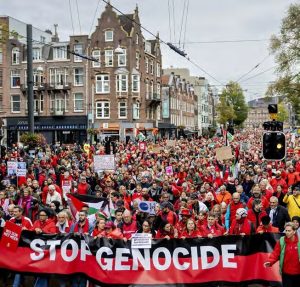
Protesters call for government action to stop the genocide in Gaza in Amsterdam, The Netherlands, on 5 October 2025. Photo by Koen van Weel/ANP/AFP
People are taking action even though they know it can be dangerous. When protests erupted in Iran in December, people came back to the streets in full knowledge that the state would respond with extreme violence.
In country after country, people from Generation Z are mobilising for the first time. Accumulated frustration at economic and political failures is being expressed through mass protests at critical tipping points: chronic electricity and water shortages in Madagascar, a social media ban in Nepal, flood control projects gutted by corruption in the Philippines. In some cases, Gen Z-led movements have forced out-of-touch governments to step aside. In Bangladesh, where a Gen Z-led uprising overthrew an entrenched authoritarian government in 2024, the country held its first credible election in almost two decades in February 2026. Even where immediate change hasn’t come, something vital has taken root. A new generation is learning from one another, connecting across borders and building the leadership skills that can sustain a long-term activist commitment.
Beyond the streets, resistance takes the form of community-level work. In conflict settings, grassroots efforts are providing essential humanitarian and mental health support and documenting violations. In US cities, neighbours have created early warning systems and physically blocked ICE operations, risking arrest and violence. Afghan women are keeping underground schools running in defiance of a regime that has made girls’ education a crime. Humanitarian groups in Europe are refusing to stop helping migrants in trouble at sea, despite being criminalised for it. These are acts of empathy, solidarity and courage.
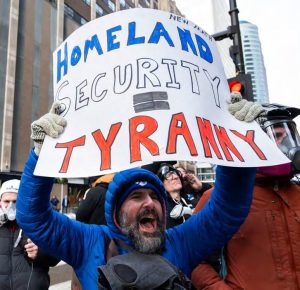
An anti-ICE protester shouts at an armoured police vehicle in Minneapolis, USA, on 17 January 2026. Photo by Roberto Schmidt/AFP
Resistance also plays the long game. Years of painstaking research, documentation and case-building against the fossil fuel industry helped secure a landmark International Court of Justice ruling establishing that states have a legal duty to protect people against climate harm, a victory that began as a campaign by a determined group of Pacific Island students. Women’s groups in the Philippines worked to document thousands of human rights violations committed by former president Rodrigo Duterte. Now he’s in ICC detention.
Persistent civil society campaigns have helped secure the release of activists jailed for peacefully exercising their rights in countries including Angola, Cameroon, Indonesia, Russia, Saudi Arabia and Venezuela. Civil society pressure forced South Africa to declare gender-based violence and femicide a national disaster. It contributed to Spain regularising the status of half a million undocumented migrants and Thailand granting around 80,000 Myanmar refugees the right to work.
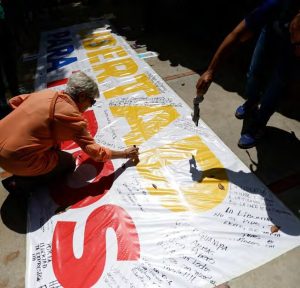
People write messages to political prisoners on a banner during a solidarity event at the Central University of Venezuela in Caracas on 31 January 2026. Photo by Pedro Mattey/AFP
Resistance is mobilising in efforts to stop tech oligarchs dictating the future. From campaigns to establish human rights safeguards for AI to coalitions demanding curbs on the military uses of technology, civil society is insisting that transformative technologies serve people, not power. At the same time, civil society is using technology for positive ends, deploying AI tools to document war crimes in Ukraine and identify victims of enforced disappearances in Mexico.
Then there are the invisible victories. Defensive wins rarely make headlines, but they’re no less vital. In a time of backlash, holding the line is an achievement. Civil society action is stalling an anti-LGBTQI+ draft law in Kenya, preventing the repeal of a ban on female genital mutilation in The Gambia and blocking moves in Latvia to weaken protections against violence against women. Resistance is working to prevent things getting worse.
Those who wield unaccountable power – men like Benjamin Netanyahu, Vladimir Putin and Donald Trump – expect to get away with their abuses, as do the oligarchs and political operatives who surround and enable them. They wouldn’t act as they do without confidence in lasting impunity.
More than anything, they want submission. They work to create the conditions for it, encouraging people to attack the vulnerable rather than the powerful. They want people to be swayed by disinformation and cowed by displays of impunity. They need people to believe problems are too big to solve, the powerful too strong to resist and the price of speaking out too high. A demotivated, divided population is a compliant one.
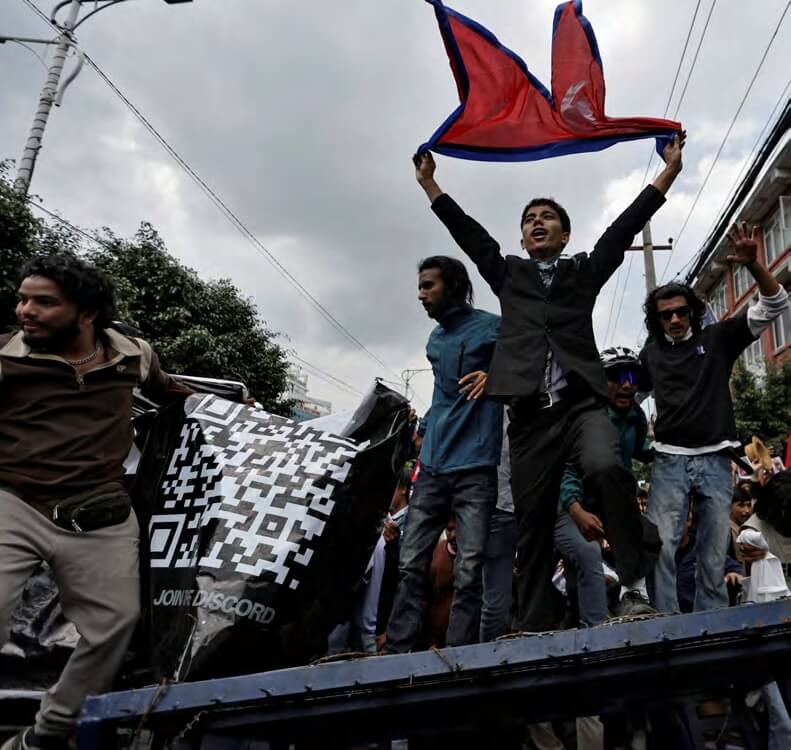
Protesters stand on a barricade during a protest against corruption and the government’s decision to block social media platforms in Kathmandu, Nepal, on 8 September 2025. Photo by Navesh Chitrakar/Reuters via Gallo Images
But those who believe in human rights and social justice know despair is a dead end. Nothing changes if nobody believes it can change. Autocrats and oligarchs understand this, which is why they work so hard to manufacture hopelessness. Resistance begins the moment people choose to hope.
Resistance is clear-eyed about the challenges but refuses to be pessimistic. Pessimism serves authoritarians, oligarchs and their allies, who insist economic and political power belong to a tiny elite and a more just world is undesirable and impossible. Resistance disagrees. Civil society knows a world is possible where no one goes hungry, struggles economically or faces violence, where everyone’s rights are respected and planetary resources are used wisely. With Gen Z-led protests, a new generation that refuses to believe it’s bound to lose has entered civic life. Resistance keeps that conviction alive.
Many of today’s mobilisations are colourful, noisy and irreverent, offering a direct repudiation of the politicians and business tycoons who think they can tell people how to act and what to believe, and who’ll never understand the power of a joke. They bring people together across barriers meant to divide them, of ethnicity, gender, nationality, sexuality and social class, and grow stronger for doing so. They’re motivated not just by economic and political grievances but also by compassion: humanity is present wherever those with relative privilege choose to use it to help people with the least access to rights.
The results are real. In Indonesia and Timor-Leste, Gen Z-led protests forced parliamentarians to abandon attempts to award themselves new benefits. Marriage equality came into effect in Liechtenstein and Thailand, and same-sex love is no longer a criminal offence in St Lucia. Denmark and Norway expanded abortion rights. In South Africa, litigation forced oil companies to put a drilling project on hold. A Greek court acquitted 24 humanitarian workers whose only crime was to help migrants at sea. The ICC convicted two militia leaders from the Central African Republic, partly based on testimony civil society collected from survivors.
This is what happens when people collectively organise, mobilise and speak out. Without these and many other civil society efforts, the world would be a grimmer place.
Current global crises – of climate, conflict, democracy, economic inequality, environmental degradation, exclusion, global governance and human rights – and the successes and failures of acts of resistance should prompt reflection on how civil society works, how change happens and what its priorities should be.
The current civil society funding crisis brings further urgency. As state and philanthropic support collapses and civic space comes under increasing restriction, it might seem understandable for organisations to seek quieter and safer roles. Some have begun scrubbing human rights language from public communications in anticipation of backlash and funding cuts. This is a self-defeating strategy. It concedes ground without a struggle and erodes the trust of communities that most need civil society’s support. Civil society must be careful not to let funders or states call the shots. It must hold on to its autonomy and keep standing up for human rights and social justice, because many states, corporations and international organisations have shown they can’t be trusted to do so.
Civil society must also guard against the dangers of self-promotion by charismatic figureheads and leaders of the biggest organisations. The temptation to chase social media virality shouldn’t come at the expense of crucial civil society values of collective action and the centring of excluded voices.
Established civil society has lessons to learn from newer movements, including those led by Gen Z. These movements are doing much with little, innovating through collective leadership, decentralised and democratic decision-making, smart social media use and creative communications that genuinely resonate with people. Civil society in global north countries can learn from the adaptation and resilience strategies practised by people in the many global south countries where civic space has been constrained for longer. It must forge new connections to enable mutual learning and challenge perceived hierarchies of knowledge.
Civil society must face the challenge that today’s issues are interconnected in ways its structures often aren’t. The technology powering deportation algorithms is the same that enables mass surveillance of activists and protesters. The funding cuts gutting migrant support organisations are also hollowing out women’s rights groups. Treating these as separate crises to be addressed by separate organisations in separate rooms is a gift to those whose power depends on people not seeing the whole picture.
Established civil society groups should also rethink who they engage with and how. This may be the time to place lower priority on high-level engagement in pursuit of incremental change, and more on finding better ways to connect with communities most affected by crises. Decades of developing international norms haven’t stopped states and corporations ruthlessly pursuing their selfish interests. Years of profile-building in international spaces haven’t stopped civil society groups being defunded and subjected to growing civic space restrictions. Where civil society groups haven’t connected with people, proved the value of their work and developed trust, they can’t count on support when they come under attack. In some countries, this disconnection enables civic space restrictions.
In a landscape of intensifying repression, those doing the work of resistance must also look after each other. Movements that burn through their people aren’t sustainable. Sustaining resistance means supporting people on the frontlines.
Those who seek to engage with and support civil society in this time of collapsing funding must also reflect. Many recent advances won by civil society have come from potentially replicable combinations of tactics. Success has often come when different groups, including unlikely allies, pool their strengths and combine their tactics in pursuit of a shared goal. Funders must make strategic choices about what to support and when to do it. A protest movement, for example, might need little and be able to crowdfund, but responses such as litigation, collection of evidence of atrocities and legal support for detained activists might be expensive or need expertise, even if they rarely attract the headlines protests do.
International Civil Society Week 2025, which brought together around a thousand activists from across the world in Bangkok, offered a glimpse of what civil society can be. The gathering was filled with the spirit of courage and solidarity this moment demands, offering powerful testimonies of resistance, sharing hard-won experience across borders and generations and renewing a collective commitment to defend civic space and demand social justice.
Civil society must take that spirit forward by keeping resistance at the heart of everything it does. This means connecting colourful, noisy street protests and bold acts of community defence with the quieter work of advocacy, documentation and litigation. While protests are its most visible face, resistance takes countless forms, from joining a community group that protects migrants and refugees to contributing to a crowdfunded litigation effort or showing solidarity with imprisoned activists. These all matter, and all become more powerful as more people add their voices. Whatever progress the future holds will come from people joining together to refuse to accept the unacceptable.