
The changing face of the World Bank and civil society’s role in the evolving institution
 By Chad Dobson
Bank Information Center
Download this article
By Chad Dobson
Bank Information Center
Summary
The World Bank is currently in flux. The global organisation has 188 member countries and over 13,000 staff working in over 130 countries. Through its public and private arms,[i] it lends over US$50 billion a year (US$52.6 billion in 2013), leverages many times more and is currently undergoing the largest institutional reorganisation in several decades.
Dr Jim Yong Kim – the 12th World Bank president – has indicated that a new, leaner Bank will be less risk adverse, more flexible and more client-oriented. It will not be afraid to take on large-scale regional and transformational projects, promote Private Public Partnerships (PPS) and increase its focus towards Fragile and Conflict-Affected States (FCS).
Given the Bank’s history of controversial projects this raises serious questions. How will the Bank’s much fought for environmental and social standards (known as “the safeguards”), which are also under review, fit into the new structure? What role will the most vulnerable and those most affected by Bank activities play? How will the Bank navigate pressure to compete with other institutions and satisfy client needs while ensuring its activities align with good practice and reach those who need it most?
This article aims to provide some insight on this changing institution and the central aspects of concern and considers whether these changes might create opportunities for, or barriers to, enhanced civil society engagement.
Drivers of change
“We will become more of a game-changing catalyst that draws billions of dollars of private sector capital into poor countries … we will leverage our fund for the poorest – IDA – to bring in other sources of capital for things like new sources of electricity and schools, especially for fragile and conflict-affected states”.[ii] – Dr Kim, President of the World Bank Group
Extensive and ongoing structural and programmatic reforms at the Bank reveal wider global influences. First, developing countries face a growing number of options for development financing. According to a recent evaluation, “In 1987, World Bank lending represented 15 percent of all external financing for developing countries. By 2002, Bank lending had declined to 4 percent.”[iii] This is linked to many global trends, including the rise of other regional development banks[iv] and the growing influence of national banks, such as the Brazilian Development Bank (BNDES) and Chinese Banks (China Development Bank and China Export Import Bank). In a recent estimate, the Chinese banks offered loans of at least US$110 billion to governments and firms in developing countries in 2009 and 2010, eclipsing World Bank lending of US$100.3 billion from its equivalent arms.[v] We are also seeing increasing South to South flows with “roughly a third of FDI [foreign direct investment] in developing countries currently originating in other developing countries,”[vi] growing private sector flows to developing countries and higher levels of remittances.[vii] This changing financial landscape forces the Bank to review its role in development, its position in the global economy and how it differentiates itself from other finance options.
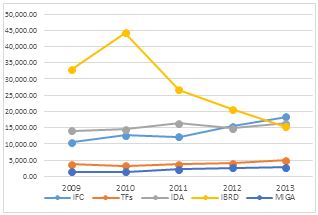
The World Bank lending profile has also changed significantly in recent years. The International Development Association (IDA), the lending arm of the Bank for poorer countries, and the International Finance Corporation (IFC), the private sector arm of the Bank, are taking up a larger proportion of the Bank’s overall lending commitments, individually overtaking the International Bank for Reconstruction and Development (IBRD) in 2013 for the first time in the Bank’s history (Figure 1). IDA is of special significance, as it has just gone through its triennial replenishment process with US$52 billion pledged for eligible countries over the next three years.[viii]
Figure 1: WB Gross Commitments (by fiscal year in US$M)
Within the IDA itself we see a changing dynamic. Many countries that were previously not invited to the table are becoming donors, and emerging markets are taking a more active role. In the previous round of negotiation (IDA16), seven new countries – Argentina, The Bahamas, Chile, Iran, Kazakhstan, Peru and the Philippines – became donors. From the IDA negotiations in 2013 (IDA17), we have seen more countries going through the graduation process[ix], such as Angola, Armenia, Bosnia and Herzegovina, Georgia and India. India’s graduation is of great significance as it has been the largest IDA borrower of all member countries (US$44.6 billion in total). New countries such as Azerbaijan, Indonesia and Thailand are also looking to become donors.[x]
China’s growing role within the institution can also be seen in IDA; it went from becoming a recipient in 1980 to a donor in 2008. China grabbed headlines by paying off US$1 billion in IDA debt ahead of time in 2011 and has recently signed a memorandum of understanding with the Bank for future cooperation. The current list of donors and their contributions from IDA17 is not yet available, but we know that for only the second time in the IDA’s history, the USA was not the highest donor, and Dr Kim has stated that emerging markets “played a very large role” in the negotiations.[xi] With vote renegotiations – which determine the voting power of countries at IDA – coming up in 2015, these changing dynamics will have a substantial impact on IDA itself and the Bank as a whole.
The shrinking number of countries eligible for IDA financing means that the Bank will need to adjust how it positions itself to address a different set of recipients. For example, an increasing percentage of eligible counties are now classified as Fragile and Conflict-Affected States (FCS). This has already had a significant impact. FCS have been a special theme[xii] in recent IDA negotiations, and earlier in 2013, Dr Kim announced that both the IDA and the IFC would increase their financing to these states by 50 percent in the next three years.[xiii]
The ever-changing global financial structure and the shifting political and economic dynamics between poorer and richer nations is not only contributing to the Bank’s modernisation process, but also increasing the significance of the Bank’s environmental and social policies. With greater resources being channelled to FCS and the Bank re-orientating towards large-scale transformational projects, it is essential that civil society continues to pressure the Bank through all avenues so that much fought for environmental and social policies are not lost along the way.
The importance of CSOs engaging in policy reform
“We need to maintain commitment to safeguards but get through the process more quickly.”
– Dr Kim, President of the World Bank Group
At the same time as its massive internal reforms, the Bank is also reviewing its key operational standards, including a two-year review of its Safeguard Policies.
The safeguards provide mandatory guidelines for projects covered under Investment Lending (IL) for its public sector lending arms the IBRD and IDA. Currently they include 10 operational policies covering a wide range of aspects, including Environmental Impact Assessments (EIAs), and issues such as forests, involuntary resettlement, indigenous peoples and dam safety.[xiv] The Bank was the first international lending institution to develop these standards, and many other organisations look to the Bank when designing their own policies.[xv]
The policies also provide the legal basis for redress for those negatively affected by Bank funded projects, through the Independent Inspection Panel (IPN). This crucial mechanism provides a strong incentive for those conducting the project to do so in an environmental and socially sustainable manner, as well as a way to align Bank activities to good practice in various areas. Often, for the most vulnerable and those whose lives are directly affected by Bank operations, these mechanisms are an avenue to raise their concerns and offer a last line of defence for those seeking restitution.
Case study: Western China Poverty Reduction Project
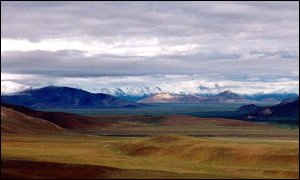 The China Western Poverty Reduction Project involved the resettlement of 58,000 people from eastern to western China, an area that is traditionally part of Tibet. It supported the creation of a dam and a large-scale irrigation system. In 1999, the International Campaign for Tibet (ICT) filed a claim to the Inspection Panel alleging that the project would threaten the cultural survival of Tibetan and Mongolian herders. The Inspection Panel discovered that various safeguard policies had been seriously violated and that a “climate of fear” in the project area made meaningful consultation impossible. CSOs lobbied Bank board members to stop the project, receiving widespread media coverage.
On 7 July 2000, the World Bank Board of Executive Directors, in a highly unusual move, rejected Bank management’s support of the China Western Poverty Reduction Project. The decision of the board to reject management’s recommendation forced the Chinese government to withdraw the project from consideration for World Bank funding.
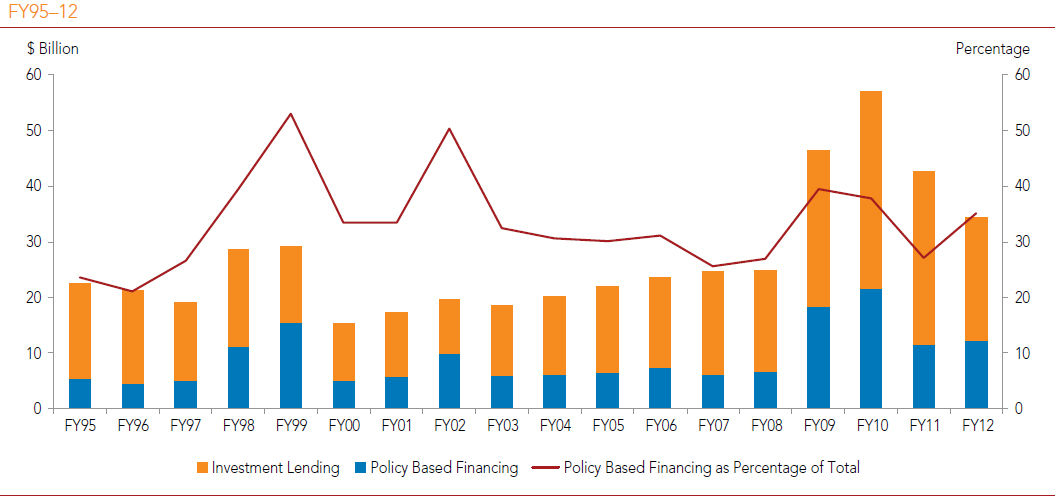
A central issue of concern is that a growing percentage of Bank lending is not covered by the safeguards. This is because the Bank is no longer providing only investment loans, but is also using a range of other lending instruments, such as Development Policy Loans (DPLs). DPLs are programmatic loans that largely fund policy reform, often through rapidly disbursed budgetary support rather than project-based physical investments. DPLs have on average constituted 30 to 40 percent of total Bank funding, but lending has in the past peaked above 50 percent of total funding.[xvi] Since 2004, DPLs have been excluded from the scope of the Bank’s environmental and social safeguard policies, including their fundamental policy on Environmental Assessment (OP 4.01). This is concerning because DPLs can have significant and long-term environmental and social impacts.[xvii] It is essential that CSOs pressure the Bank for wider application of safeguards across the entire portfolio.
Total World Bank DPL and Investment Lending 1995-2012
Given that many of the operational policies contained in the safeguards were developed in the 1980s and 1990s, it is vital that the review addresses current gaps in policies and aligns the safeguards with the highest international standards. This should mean, at a minimum, incorporating into the revised safeguards a respect for all fundamental human rights, including explicit protections for the rights of children, persons with disabilities and sexual minorities. The safeguards should also recognise the right to free prior and informed consent (FPIC) for indigenous peoples and include binding policies to address fully the impacts of projects on issues of climate change, gender, labour, land tenure and natural resources.
A key question for the change process is how the Bank will navigate which responsibilities should lie with borrowing countries and which should be mandatory loan requirements. Borrower country systems can and should be used when those systems can be demonstrated to offer robust, transparent and inclusive processes that are equivalent to international standards and when countries not only have good policies on paper but the institutional capacity to implement them on the ground. As a fundamental development goal, national systems should be strengthened. What is unacceptable is a transfer of responsibility and accountability for safeguard outcomes to borrowers with a concomitant loosening of safeguard compliance at appraisal and open-ended compliance during implementation.
As the Bank attempts to reposition itself in the changing global environment it is important that lessons from the past are not forgotten. The safeguards are a direct embodiment of the Bank’s ability to learn from its history, as most of the safeguard policies have arisen directly out of disastrous projects and from an incredible amount of work involving civil society across the world.[xviii] Any dilution of the policies – or lack of ability to apply them to a large section of their portfolio – could have substantial knock-on effects for how projects and policies are conducted in developing countries. Aside from the IPN, the Bank has four other major oversight mechanisms.[xix] How these will fit in the new corporate strategy and whether they will have the resources to achieve their mandate is still very unclear. It is crucial that CSOs continue to pressure the Bank by engaging in their change process and policy review in every way possible.
Prepare to engage
“We are here today because we believe that listening to citizens is central to doing development better.” – Dr Kim, President of the World Bank Group
As mentioned, the safeguards and the IPN are essential mechanisms to keep the Bank in line, but when a project gets to that stage, it already has significant problems, and it may be too late to prevent damage. With Dr Kim’s agenda of being less risk adverse, encouraging large-scale project and increasing investment in Fragile and Conflict-Affected States, it is essential to conduct appropriate research, risk analysis and consultations with all relevant stakeholders – early in the process – in the development of country strategies.
The Bank will be implementing a new model for how it develops programmatic plans in borrowing countries, using the following new instruments: A Systematic Country Diagnostic (SCD); a Country Partnership Framework (CPF), which would replace the current Country Assistance/Partnership Strategy (CAS/CPS); and Performance and Learning Reviews. Much of the details of the Bank’s new strategy and instruments are still unclear, even to senior Bank management itself, and are yet to be fully fleshed out and developed. This presents an opportunity for CSOs and other stakeholders to engage early with the Bank to influence the design and the mechanics of these components, which will ultimately set the foundation for how the Bank engages with countries and their citizens.[xx]
Over the years the Bank has made significant improvements in its openness and methods to engage with CSOs, particularly since the inception of its 2009 landmark Access to Information Policy. At its annual meetings in 2013 the Bank released new consultation guidelines and a consultation hub (consultations.worldbank.org). Both these are very welcome developments, and the guidelines set strong principles for Bank staff to refer to when organising consultations. However, the guidelines are not binding or mandatory in any way, and exactly how they are implemented is yet to be seen.
The World Bank Group has recently committed to mainstreaming citizen engagement (CE) across country engagements and operations. Perhaps not surprisingly – given the recent political and social shifts in the region – the Bank has opted to pilot the CE initiative in the Middle East and North Africa (MENA) region. This is a welcome but challenging step, and we will be interested to see how the Bank rolls out its plans, given that the initiative in many ways consolidates much of what civil society has been demanding for a while. A cautionary note is that while the CE guidance note places considerable weight on non-state actors being able to hold their governments accountable, it perhaps does not assign enough weight to how the Bank is committed to maintaining responsibility for the projects and programmes that it funds. The Bank Information Center (BIC)’s MENA team will be producing more in-depth analysis of the CE programme.
In the last few years, the Bank has developed a number of online tools that are potentially helpful for enhancing citizen engagement, including: Mapping for Results (map.worldbank.org), which shows IBRD and IDA project across the world (although currently it doesn’t include past or pipeline projects); AidFlows (www.aidflows.org), which visualises development aid flows; eAtlas, a suite of interactive electronic atlases that allow users to map and graph dozens of indicators over time and across countries; and AidData (www.aiddata.org). There are also a number of mobile phone applications (often referred to as “apps”) for development and poverty indicators – on Africa, climate change, education, health, gender and jobs (data.worldbank.org/apps). In addition, the Bank has recently adopted, on a pilot basis, the application of Creative Commons (CC) licenses to many of its publications and launched the Open Knowledge Repository (OKR), which currently gives online access to 13,000 of its research and knowledge products.
BIC, as a member of CIVICUS, has also been actively promoting greater transparency and encouraging space for greater civil society engagement amongst the Bank’s board of Executive Directors (EDs). Aside from the World Bank governors, which meet twice a year, the EDs are the highest governing body and often have the final say in approving projects and policy changes. Currently the EDs – who represent all member countries and their citizens – are all based in Washington, DC, and engaging with them is problematic, given that their travel schedules are not published and their websites are often outdated.
Despite having an incredibly influential role in committing very large sums of public money, much of the EDs’ correspondence is confidential, and the majority of documents are only available after decisions have been made.[xxi] BIC, CIVICUS and other partners are working to address some of these concerns and promote greater space for civil society engagement in this central decision-making body.
Holding Kim to his rhetoric
“It’s not so often that an activist from civil society gets to run the largest development organisation in the world. I guarantee you that I am not going to let this opportunity slip through my fingers.” – Dr Kim, President of the World Bank Group, 2012
The coming period for the Bank will have a tremendous influence on the institution’s trajectory and thus an incredible effect throughout developing countries. The changing global landscape has meant the Bank has had to rethink its role in the development game; the unprecedented scale of its restructuring, refocusing and modernisation process means that much at the moment is unknown. The Bank is no longer the only game in town, and formerly reticent countries are now voicing their opinions and flexing their muscles. Many parts of the Bank have opened up their dark hallways, releasing decades of information to the public, and the growing range of technology has given people new ways of spreading and interpreting this data.
The Bank has a long and chequered history. Its role in the future will depend not only on it listening, but also on incorporating knowledge from all stakeholders, and committing – not just in rhetoric – not only to its goals of ending extreme poverty within a generation and reducing inequality, but also going further, to put in place the mechanisms and resources to achieve this in a participatory, environmentally and socially sustainable way.
[i] International Bank for Reconstruction and Development (IBRD) 1944, International Development Association (IDA) 1960, International Finance Corporation (IFC) 1956, the International Centre for the Settlement of Investment Disputes (ICSID) 1966, and the Multilateral Investment Guarantee Agency (MIGA) 1988.
[ii] J Kim, Remarks at the Annual Meetings 2013 Closing Press Conference, World Bank Group, 12 October 2013, http://www.worldbank.org/en/news/speech/2013/10/12/world-bank-group-president-jim-yong-kim-closing-press-conference .
[iii] The Matrix System at Work: An Evaluation of the World Bank’s Organizational Effectiveness, Independent Evaluation Group, April 2012, https://openknowledge.worldbank.org/handle/10986/12230 .
[iv] These include the African Development Bank (AfDB), Asian Development Bank (ADB), Caribbean Development Bank (CDB), European Bank for Reconstruction and Development (EBRD) and Inter-American Development Bank (IADB).
[v] G Dyer, J Underline and H Sender, China’s lending hits new heights, Financial Times, 17 January 2011,
http://www.ft.com/intl/cms/s/0/488c60f4-2281-11e0-b6a2-00144feab49a.html#axzz2rwioi7rE .
[vi] Draft of IDA17 Deputies’ Report, International Development Association, November 2013, http://www.worldbank.org/ida/papers/IDA17_Replenishment/deputies-draft-report-november-2013.pdf
[vii] Ibid.
[viii] World Bank’s Fight against Extreme Poverty Gets Record Support, World Bank Group Press Release, 12 December 2013, http://www.worldbank.org/en/news/speech/2013/10/12/world-bank-group-president-jim-yong-kim-closing-press-conference .
[ix] Countries eligibility to receive IDA funding depends on a number of factors including being below certain threshold such as GNI per capita (US$1,204 in 2014) and creditworthiness. Once countries pass this threshold they ‘graduate’ and become eligible for IBRD funding. There are some countries which are eligible for both, called blend countries.
[x] IDA Replenishment – Second Meeting Chairperson’s Summary, International Development Association (IDA), 1-4 July 2013, http://www.worldbank.org/ida/papers/IDA17_Replenishment/IDA17ManaguaSummary.pdf .
[xi] J Kim and J von Amsberg, Transcript: Teleconference on IDA17 Replenishment with World Bank Group President Jim Yong Kim, 17 December 2013, http://www.worldbank.org/en/news/speech/2013/12/17/transcript-ida17-replenishment-world-bank-group-president-jim-yong-kim .
[xii] Areas of more focus, analysis and strategic discussion during the replenishment process.
[xiii] J Kim, The World Bank Group Strategy: A Path to End Poverty, World Bank Group President Jim Yong Kim’s Speech at George Washington University, 1 October 2013, http://www.worldbank.org/en/news/speech/2013/10/01/world-bank-group-president-jim-yong-kim-speech-at-george-washington-university .
[xiv] In full, they are: OP 4.01: Environmental Assessment, OP 4.04 Natural Habitats, OP 4.36 Forests, OP 4.09 Pest Management, OP 4.11 Physical Cultural Resources, OP 4.12 Involuntary Resources, OP 4.10 Indigenous Peoples, OP 4.37 Safety of Dams, OP 7.5 International Waterways, OP 7.60 Disputed Areas.
[xv] K Herbertson, Will Safeguards Survive the Next Generation of Development Finance? International Rivers, 2012, http://www.internationalrivers.org/resources/will-safeguards-survive-the-next-generation-of-development-finance-7591 .
[xvi] 2012 Development Policy Lending Retrospective: Results, Risks and Reforms, Operations Policy and Country Services, World Bank, 2012, http://viewer.zmags.com/publication/78847067#/78847067/1 .
[xvii] World Bank Safeguards and Development Policy Review: A Primer of Why DPLs Should be Part of the Safeguards Review, Bank Information Center and Global Witness, 2013, http://www.bicusa.org/issues/safeguards/environmental-and-social-assessment/ .
[xviii] Above fn 15.
[xix] These are: Independent Evaluation Group (IEG), Compliance Advisor/Ombudsman (CAO), Internal Audit Vice Presidency (IAD) and the Integrity Vice Presidency (INT).
[xx] International Finance Institutions in the Middle East and North Africa – Newsletter Issue 8, Bank Information Center, 2013, http://www.bicusa.org/international-financial-institutions-in-the-middle-east-and-north-africa-issue-8/ .
[xxi] For more information, please see: http://documents.worldbank.org/curated/en/disclosure .